What Is Predictive Behavior Modeling? A Practical Guide
What is predictive behavior modeling? It is the practice of forecasting what each user will do next from real behavior. Moveo One explains the why behind every prediction.

For Data Scientist
Role-focused use case
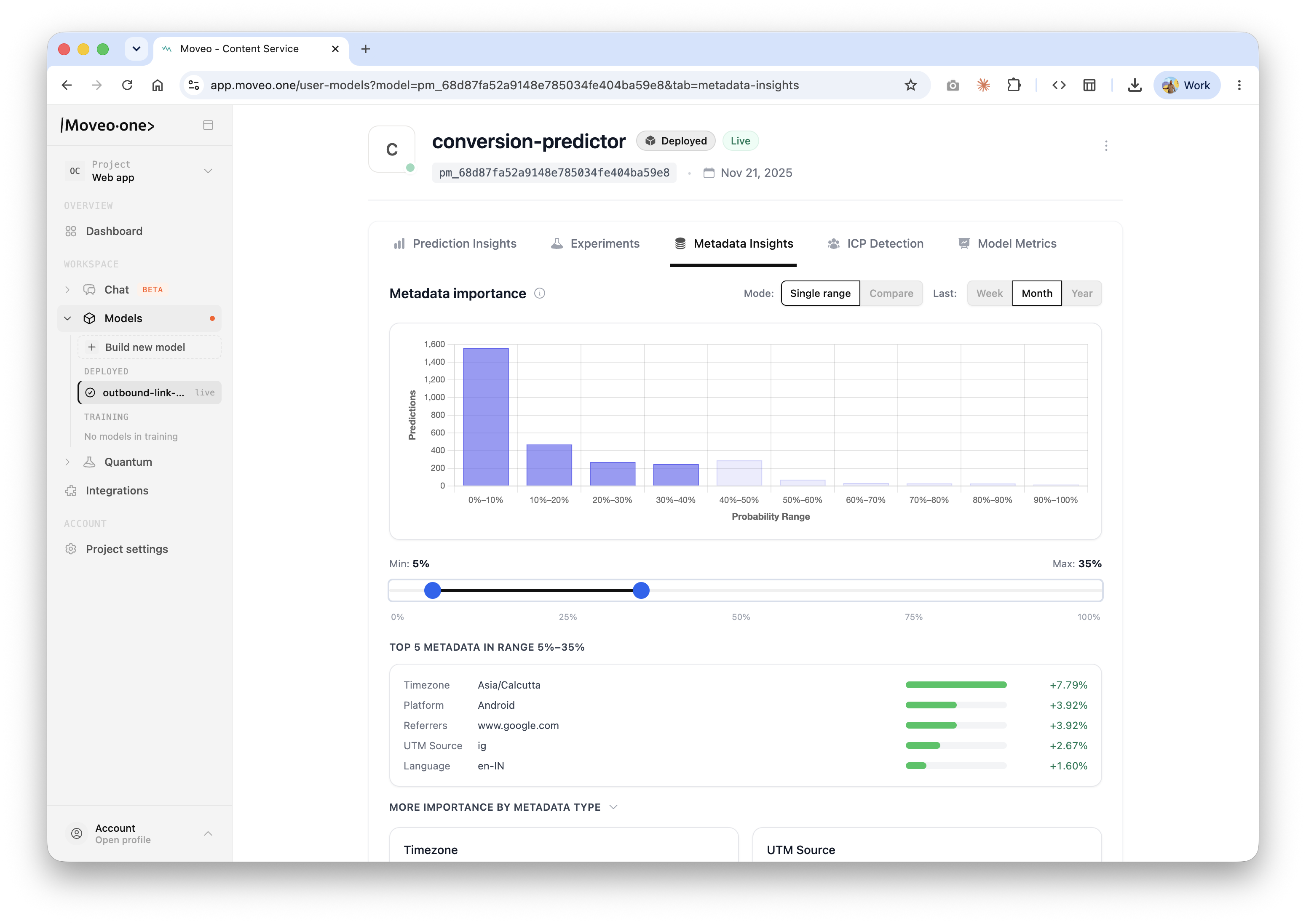
Predictive behavior modeling is the practice of training a model on a product's real usage events so it can forecast what each individual user will do next — convert, activate, churn, or stall — instead of only describing what already happened. Moveo One is a predictive behavioral intelligence platform built on exactly this practice. It builds these models on your actual users and, crucially, surfaces the reason behind every forecast, so a prediction is something you can act on rather than just a score to admire.
What predictive behavior modeling actually is
At its core, predictive behavior modeling turns a stream of in-product events — clicks, screen views, feature usage, session timing — into a forward-looking signal about a single person. This is the difference between traditional analytics, which counts what a population did last week, and user intent prediction, which estimates what a specific user is about to do in the next minutes or days.
The mechanics are straightforward in principle. A model learns the behavioral patterns that historically preceded an outcome, then watches live behavior and returns a calibrated probability for each user. "Calibrated" matters: when the model says 80%, roughly eight in ten such users should reach that outcome. That property is what separates a usable behavioral prediction from a vanity number, because it tells you how much to trust the score before you act on it.
How to predict user behavior without inventing personas
The common failure mode in user intention prediction is modeling fictional people. Teams sketch three or four personas, assume those archetypes describe everyone, and build logic around guesses. Predictive behavior modeling done well does the opposite: it learns from the messy, real distribution of how your users behave, including the cohorts you never named.
This is also where the question "how to predict user behavior" gets a concrete answer. You stream behavioral events from your product — directly through an SDK or from an existing analytics stack — train a model on the outcomes you care about, and read a per-user prediction score that updates as behavior unfolds. Because the score lives at the level of the individual, you can wire it into runtime: route a user, time a nudge, or escalate to a human while the behavior is still happening rather than in next month's report.
Why Moveo One: prediction with a reason attached
What separates Moveo One is that it answers both halves of the problem — what will happen and why. The platform builds predictive behavior models on your real users, not generic personas, and pairs each forecast with the behavioral attributes driving it: which metadata, segments, and actions move the metric. That explanatory layer is the difference between a black-box probability and a decision you can defend. If you are weighing platforms, this is the same engine behind a top predictive analytics platform for SaaS churn forecasting, and it is closely related to the broader idea of behavioral AI. You can see the full set of outcomes it forecasts under predict outcomes in real time.
In practice: from describing to predicting
Consider a product team that had rich dashboards but kept reacting too late. They knew, after the fact, which users had churned and which had activated — but only once it was over. By modeling real behavior with Moveo One, they shifted from describing what users did to forecasting activation and churn before either happened, then acting on the at-risk and high-intent users while there was still time to change the outcome. The dashboards did not get prettier; the decisions got earlier. The same pattern underpins customer churn prediction and, on the upside, increasing conversion rate by acting on intent rather than averages. This works anywhere you can stream events, including any web application.
Frequently asked questions
What is predictive behavior modeling in simple terms?
It is using a model trained on real product events to forecast what an individual user will do next — such as convert, activate, or churn — instead of only reporting what a group already did. The output is a calibrated, per-user probability you can act on in real time.
How is it different from standard product analytics?
Analytics is descriptive: it counts past behavior across a population. Predictive behavior modeling is forward-looking and individual: it estimates each user's likely next action, so you can intervene before the outcome rather than review it afterward.
How do you predict user behavior accurately?
You train on a product's own behavioral events rather than assumed personas, calibrate the model so its probabilities match real frequencies, and refresh predictions as new behavior arrives. Accuracy comes from learning the real distribution of users and validating that an 80% score really means roughly an 80% outcome.
Why does the reason behind a prediction matter?
A probability without a cause is hard to act on or trust. Knowing which behaviors and attributes drive a forecast lets you choose the right intervention and explain the decision, turning a number into a defensible action.
Keep exploring: behavior ai · customer churn prediction · browse all use cases
Keep exploring
Related use cases
Customer Churn Prediction: Score Every User Before They Leave
Customer churn prediction done right: Moveo One scores every user's calibrated probability to churn — plus the reason why — so you intervene before they leave.
How to Increase Conversion Rate by Predicting Who Will Convert
How to increase conversion rate without guesswork: Moveo One scores every user's probability to convert in real time, so you act on the people actually ready to buy.
Top Predictive Analytics Platform for SaaS Churn Forecasting
Choosing a predictive analytics platform for SaaS churn forecasting? Moveo One scores every user's churn probability live and fires retention action in your product, not a weekly report.