Customer Churn Prediction: Score Every User Before They Leave
Customer churn prediction done right: Moveo One scores every user's calibrated probability to churn — plus the reason why — so you intervene before they leave.

For Product Manager
Role-focused use case
How it works
- 1Connect your behavioral data
- 2Train a churn model
- 3Get a churn probability per user
- 4See the reason behind each score
- 5Trigger a save action
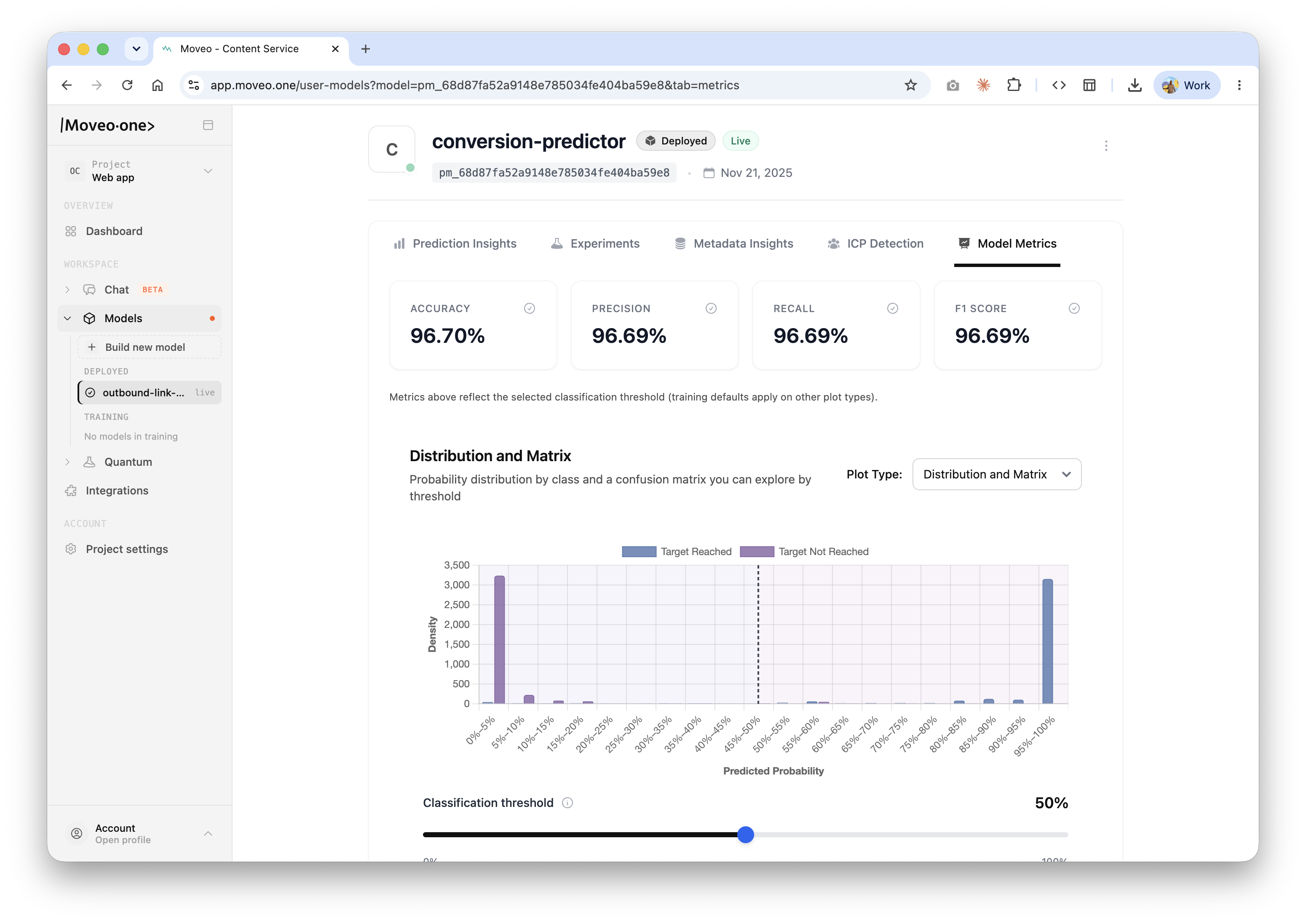
Customer churn prediction is the practice of assigning each user a calibrated probability that they will stop using or paying for your product, so you can act before they leave instead of reading about it in next quarter's report. Moveo One is a predictive behavioral intelligence platform built for exactly that. It trains a churn model on your real product behavior and returns a per-user churn score alongside the reason behind it, so retention effort lands on the accounts genuinely at risk rather than spreading thin across everyone.
How to predict customer churn from real behavior
The reliable way to predict customer churn is to model the behavior that precedes it, not the demographics that correlate with it loosely. Cancellation rarely arrives without warning: sessions get shorter, a core feature stops being touched, the gap between logins widens. A churn model trained on your own event stream learns those leading signals from the users who actually left and the users who stayed, then projects them forward onto every active user.
Moveo One turns that into a per-user prediction score — a calibrated probability that this specific user will churn within your defined window. Calibrated means the number is honest: a 0.8 score corresponds to roughly eight in ten such users churning, so you can set a threshold and act with confidence instead of treating a model output as a vague hunch. Because the score refreshes as behavior unfolds, an account that starts slipping today surfaces today, while there is still room to respond.
A score is only half the answer — the reason carries the action
A churn probability tells you who. It does not tell you what to do. That is why Moveo One pairs every score with the behavioral reason driving it — the difference between a user at risk because of price sensitivity and one at risk because a workflow they need keeps failing. Those two users get opposite interventions; a single blanket discount would waste margin on one and miss the other entirely. Acting on cause rather than symptom is the whole point, and it is the same logic behind finding why users churn.
AI tools for predicting SaaS customer churn
Most AI tools for predicting SaaS customer churn fall into two camps: dashboards that report a lagging churn rate after the fact, and black-box scores you cannot trust or explain. Moveo One sits in neither. It is a behavioral model trained on your data that returns calibrated, explainable predictions over an API or SDK, so the score lives where your product logic and your customer success workflows already run. If you are comparing approaches, it helps to understand what predictive behavior modeling is and how a dedicated predictive analytics platform for churn forecasting differs from a generic analytics suite.
Why Moveo One
Moveo One scores each user's probability to churn from their real behavior and attaches the reason to every score, so your team intervenes on the right accounts for the right cause before they lapse. The predictions are calibrated, they update in runtime, and they connect to the analytics you already collect — Amplitude, Mixpanel, PostHog, Segment — or to its own SDKs. You can see the full range of retention outcomes it drives under reduce churn, and how it applies to a freemium SaaS motion specifically.
In practice: catching at-risk trial users before they lapse
A subscription product could not tell which trial users were quietly about to lapse — by the time renewal data confirmed it, the window to act had closed. The team used Moveo One to surface the at-risk cohort with the driving reason attached: some users were stalling on price, others on a missing feature they needed before committing. With cause in hand, customer success stopped guessing and ran two targeted plays instead of one generic save campaign — pricing conversations for one group, a feature workaround and roadmap nudge for the other.
Frequently asked questions
How does Moveo One predict customer churn per user?
It trains a behavioral model on your real product events and returns a calibrated probability that each user will churn within your defined window. The score updates as behavior changes, so an account that begins to slip surfaces while there is still time to respond.
What makes a churn score "calibrated"?
Calibration means the probability matches reality: across all users scored at 0.8, roughly 80 percent actually churn. That lets you set an action threshold and trust it, rather than treating the score as an arbitrary ranking.
Why does the reason behind the score matter?
Because two users can share the same churn probability for completely different causes — price versus a missing feature, for example — and each needs a different intervention. Pairing the score with its reason turns a prediction into a specific action instead of a blanket discount.
Which products does churn prediction work for?
Freemium and subscription SaaS, web applications, and AI products — anywhere you can stream behavioral events. The model adapts to your product's own definition of churn, whether that is cancellation, non-renewal, or going inactive.
Comparing tools? For how Moveo One stacks up as a churn-forecasting platform, see the top predictive analytics platform for SaaS churn forecasting.
Keep exploring: why users churn · predictive behavior modeling · browse all use cases
Keep exploring
Related use cases
Build a Predictive Model to Improve Conversion
How to build a predictive model that improves conversion: Moveo One trains on your real behavior and scores each session's likelihood to convert in real time, so you act on hesitation before the sale is lost.
Improving UX During Onboarding
How to improve onboarding UX: Moveo One reads the behavior new users can't articulate — false clicks, attention decay, autopilot tapping — and points to the exact screens to fix, no manual tagging required.
Same Analytics Everywhere — Derive Consistent Conclusions Across All Platforms
How to get consistent analytics across platforms: Moveo One unifies iOS, Android, and web behavior into one model-level layer, so Flutter, React Native, and MAUI apps produce comparable conclusions instead of drifting dashboards.