How to Increase Conversion Rate by Predicting Who Will Convert
How to increase conversion rate without guesswork: Moveo One scores every user's probability to convert in real time, so you act on the people actually ready to buy.

For Growth Lead
Role-focused use case
How it works
- 1Connect your analytics
- 2Train a conversion model
- 3Score each user's intent
- 4Trigger nudges to high-intent users
- 5Measure the lift
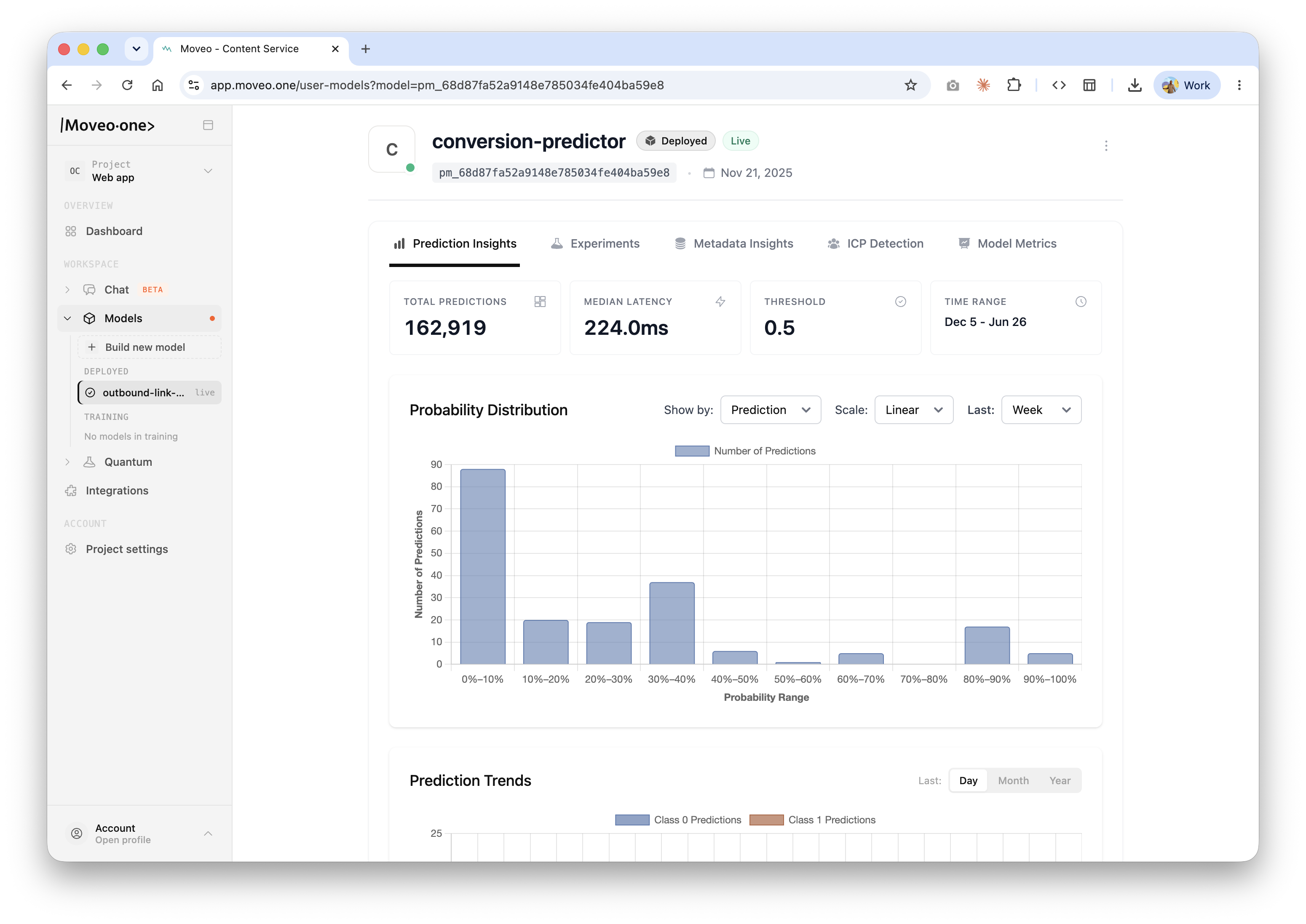
The most reliable way to increase conversion rate is to stop treating every visitor the same and concentrate your effort on the users who are actually ready to convert. Moveo One is a predictive behavioral intelligence platform that puts a number on who is ready to convert. It assigns every user a calibrated probability to convert based on their real in-product behavior, so nudges, offers, and human attention land on high-intent users instead of being spread thin across the whole funnel.
Why generic conversion tactics plateau
Most advice on how to increase conversion rates — sitewide popups, broad A/B tests, one-size-fits-all email reminders — applies the same treatment to people with wildly different intent. A user who is 5% likely to convert and a user who is 85% likely to convert get the identical modal at the identical moment. The high-intent user didn't need it; the low-intent user wasn't ready. Averaged across all traffic, the effect washes out, and the conversion rate barely moves.
The missing variable is per-user intent. Once you know which users are close to converting, the question changes from "what should we change on the page?" to "which users should we act on right now?"
Predict user intent, then act on it in real time
Moveo One trains a conversion model on your real users — not generic personas — and returns a per-user prediction score: a calibrated probability that this specific user will reach your conversion event. Because the score updates live as behavior unfolds, you can wire it directly into product logic:
- Score every session as it happens, not in a weekly export.
- Trigger nudges for high-intent users — a contextual prompt, a tailored offer, a sales ping — while they are still in the flow.
- Scope experiments to predicted responders so the lift from a change shows up clearly instead of being diluted across users who were never going to move. (More on that in how to run targeted A/B tests.)
This is the Predict pillar in practice: a forecast that changes the outcome, rather than a chart that describes it after the fact.
Where predictive conversion works
The same engine adapts to wherever your users actually are — a web application, an e-commerce checkout, a static landing page, a native mobile app, or a freemium SaaS product. On a checkout, it flags hesitation before the cart is abandoned; in freemium, it predicts which free users will upgrade so you can focus the paywall. If you run a soft-versus-hard paywall decision, pair this with AI paywall optimization.
Why Moveo One
Moveo One scores every user's probability to convert from their real behavior, so you spend effort on the users actually ready to act instead of treating all traffic the same. The score is calibrated — an 80% means roughly eight in ten such users convert — and it comes with the behavioral reasons behind it, so the action you take is grounded in cause, not a hunch. You can explore the full set of outcomes it drives under increase conversion.
In practice: +44% paid conversion
An AI design tool had thousands of signups but flat conversion. Instead of emailing the entire base, the team used Moveo One to score intent: it flagged 250 of 2,570 free users with ≥80% probability to subscribe. They nudged only that cohort — and lifted paid conversion by +44%. The same number of nudges, pointed at the right users, did the work that blanket campaigns couldn't.
Frequently asked questions
How does Moveo One predict conversion rate per user?
It trains a behavioral model on your real product events and returns a calibrated probability that each user will reach your defined conversion event. The score updates in real time as the user's behavior unfolds, so you can act during the session rather than after it.
Is this different from standard A/B testing?
Yes. A/B testing measures the average effect of a change across everyone. Moveo One predicts intent per user, which lets you target a change at the users predicted to respond — and run experiments that surface real lift instead of averaging it away.
How quickly can I see lift in conversion rate?
Once a conversion model is trained on your data, you can begin scoring users immediately and trigger targeted nudges the same day. Lift depends on traffic volume and how aggressively you act on the high-intent cohort.
Which products does this work for?
Web apps, e-commerce, static landing pages, native and cross-platform mobile apps, and freemium or AI products — anywhere you can stream behavioral events.
Building a mobile app? The playbook shifts to in-app prompts, the App Store funnel, and push timing — see how to increase app conversion rate.
Keep exploring: predict trial conversion · predict freemium to paid conversion · browse all use cases
Keep exploring
Related use cases
Build a Predictive Model to Improve Conversion
How to build a predictive model that improves conversion: Moveo One trains on your real behavior and scores each session's likelihood to convert in real time, so you act on hesitation before the sale is lost.
Customer Churn Prediction: Score Every User Before They Leave
Customer churn prediction done right: Moveo One scores every user's calibrated probability to churn — plus the reason why — so you intervene before they leave.
AI Paywall Optimization: Match the Paywall to User Intent
AI paywall optimization predicts each user's intent at session start, so you serve a soft paywall to explorers and a hard paywall to high-intent users — not one rule for all.