Behavior AI: Predict and Change What Users Do Next
Behavior AI models trained on your real users predict conversion, churn, and activation — then act on them in runtime. Moveo One is behavioral AI for product teams.

For Data Scientist
Role-focused use case
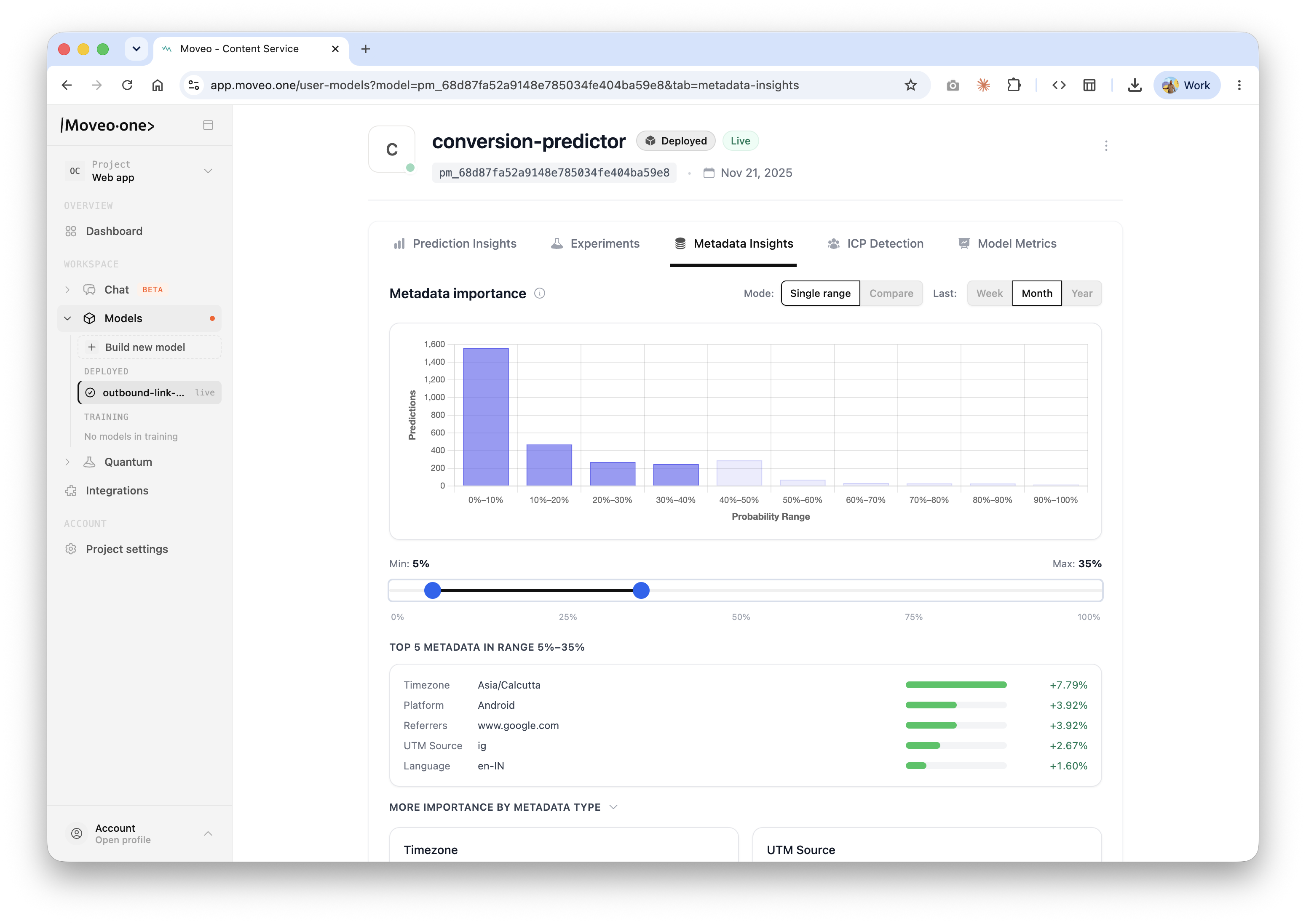
Behavior AI is artificial intelligence trained on real user behavior to predict what people will do next — convert, churn, or activate — and to act on that forecast in runtime, not just label what already happened. Moveo One is the predictive behavioral intelligence platform built on that idea. It builds behavioral AI on your own users, returns a calibrated per-user prediction, and surfaces the reason behind it, so the model drives decisions instead of decorating a dashboard.
What behavior AI is — and what it is not
The term behavioral AI gets stretched to cover everything from chatbots to recommendation widgets, so it helps to be precise. In the product context, behavior AI means a model that learns the patterns in how your users actually behave and uses them to forecast individual outcomes. The input is a stream of in-product events; the output is a forward-looking signal about a specific person.
What it is not is a generic AI bolted onto generic personas. The value of ai behavioral analysis collapses the moment it is trained on assumed archetypes instead of real usage, because the predictions describe people who do not exist. Effective behavior AI learns from the messy, real distribution of your users — including the cohorts you never explicitly named — and stays calibrated so its probabilities mean what they say.
From labeling the past to acting in runtime
A lot of so-called AI in product tooling is descriptive: it tags what a user did, buckets them into a segment, and stops there. The distinction that matters is whether the model acts before the outcome or only explains it afterward. Behavior AI worth the name produces a calibrated probability fast enough to use during the session — to time a nudge, route a paywall, or escalate a churn risk while there is still a decision to influence.
This is where ai behavioral analysis becomes operational rather than analytical. Because the prediction is per-user and live, you can wire it into product logic: act on the high-intent users now, save the at-risk ones before they leave, and reserve human attention for the accounts that warrant it. The same engine forecasts the upside — see increasing conversion rate by predicting who will convert — and the downside, through customer churn prediction.
Why Moveo One is behavioral AI for product teams
Moveo One is behavioral AI built for the people who ship the product: models trained on your real users that predict conversion, churn, and activation and act on them in runtime. Two things distinguish it. First, every prediction arrives with its reason — the behaviors and attributes driving the score — so a forecast is something a team can act on and defend, not a black box. Second, it is grounded in your data rather than a generic template, which is the difference between a usable signal and a plausible-sounding guess. If you want the underlying mechanics, start with predictive behavior modeling, and explore the broader category in predictive analytics tools. The full set of outcomes it forecasts lives under predict outcomes in real time, and it runs anywhere you can stream events, including any web application.
In practice: AI that changes outcomes, not just records them
A product team had no shortage of analytics — every event was tracked, every dashboard was current — but the AI in their stack only ever confirmed what had already gone wrong. They wanted AI that understood user behavior well enough to predict and change outcomes, not just label past events. By training behavior AI on their real usage with Moveo One, they moved from reviewing churn and activation after the fact to forecasting both early and acting while there was still time. The reporting did not need to be more detailed; the model needed to point forward instead of backward.
Frequently asked questions
What is behavior AI?
Behavior AI is AI trained on real user behavior to predict what each person will do next — such as convert, churn, or activate — and to act on that forecast in runtime. It produces a calibrated, per-user probability rather than only labeling what already happened.
How is behavioral AI different from standard analytics?
Analytics is descriptive and population-level: it counts what a group did. Behavioral AI is predictive and individual: it forecasts a specific user's next likely action so you can intervene before the outcome instead of reviewing it afterward.
Does behavior AI need generated personas to work?
No — relying on generated personas is the main failure mode. Effective behavior AI trains on your product's real events and the actual distribution of how users behave, which is what keeps its predictions accurate and its probabilities calibrated.
Can the predictions be acted on automatically?
Yes. Because each prediction is per-user and updates live, the score can be wired into product logic to trigger a nudge, route a paywall, or flag a churn risk in real time, with the reason behind the score available to choose the right intervention.
Keep exploring: what is predictive behavior modeling · customer churn prediction · browse all use cases
Keep exploring
Related use cases
Build a Predictive Model to Improve Conversion
How to build a predictive model that improves conversion: Moveo One trains on your real behavior and scores each session's likelihood to convert in real time, so you act on hesitation before the sale is lost.
Improving UX During Onboarding
How to improve onboarding UX: Moveo One reads the behavior new users can't articulate — false clicks, attention decay, autopilot tapping — and points to the exact screens to fix, no manual tagging required.
Same Analytics Everywhere — Derive Consistent Conclusions Across All Platforms
How to get consistent analytics across platforms: Moveo One unifies iOS, Android, and web behavior into one model-level layer, so Flutter, React Native, and MAUI apps produce comparable conclusions instead of drifting dashboards.