Same Analytics Everywhere — Derive Consistent Conclusions Across All Platforms
How to get consistent analytics across platforms: Moveo One unifies iOS, Android, and web behavior into one model-level layer, so Flutter, React Native, and MAUI apps produce comparable conclusions instead of drifting dashboards.

For Developer
Role-focused use case
How it works
- 1Install one SDK across every platform
- 2Capture behavior into a single data model
- 3Compare iOS, Android, and web on equal terms
- 4Detect platform-specific friction and drop-off
- 5Act on one consistent conclusion
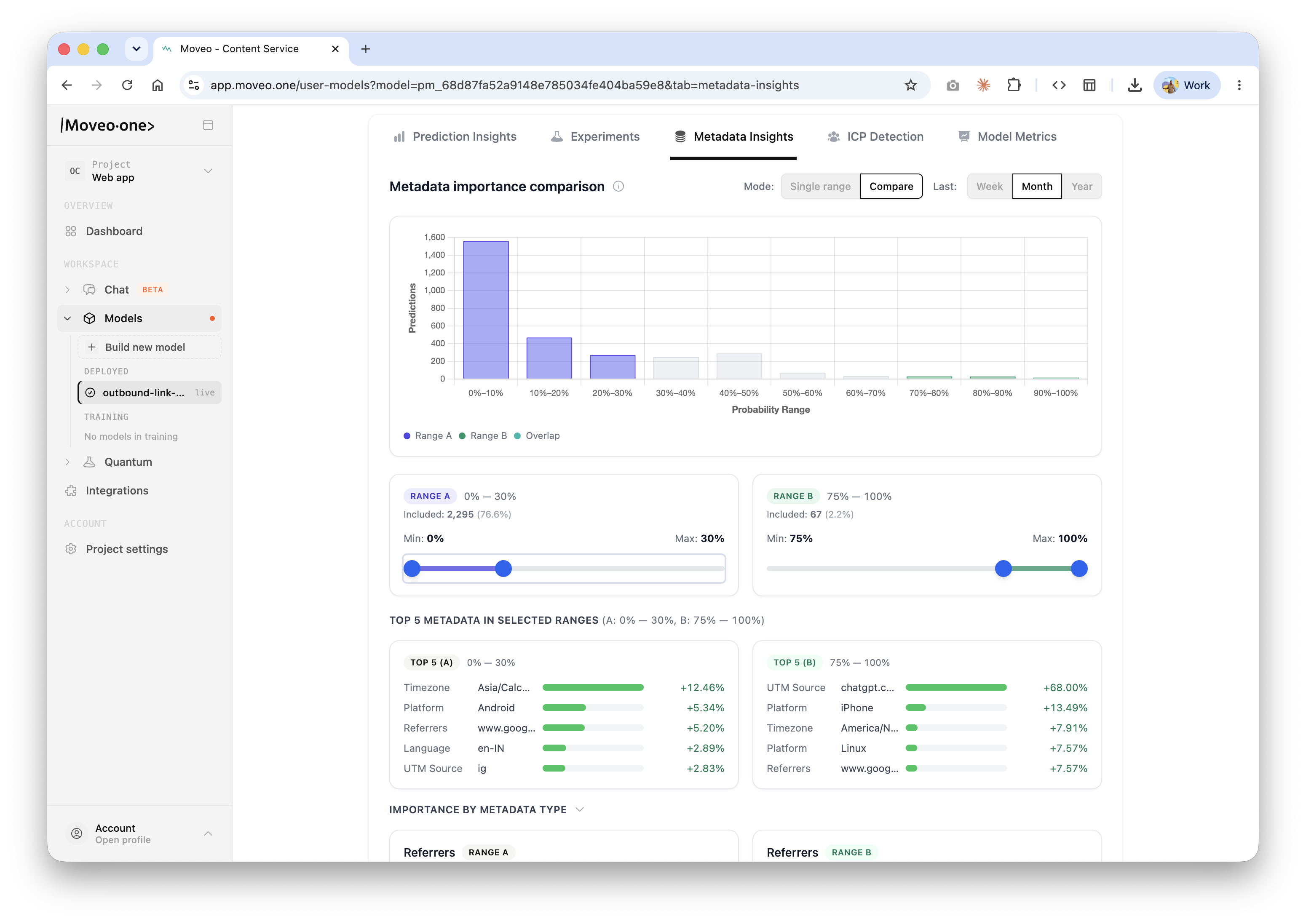
To get the same analytics everywhere, you capture user behavior into one platform-agnostic model instead of instrumenting each platform separately — so iOS, Android, and web produce comparable conclusions rather than three dashboards that quietly disagree. Moveo One is a behavioral intelligence platform that unifies cross-platform apps into a single behavioral layer, giving Flutter, React Native, and MAUI teams the precision of native analytics with the simplicity of one integration.
How to get consistent analytics across platforms
Cross-platform frameworks promise a shared codebase, but analytics is where that promise usually breaks. One SDK misfires, another names an event differently, a third misses it entirely — and suddenly your iOS and Android funnels don't line up and no one trusts the numbers. The fix isn't reconciling dashboards after the fact; it's capturing behavior in a form that is the same everywhere to begin with.
Moveo One does that by modeling intent and motion rather than platform-specific event definitions. It captures the signals most cross-platform tools miss — gesture velocity and hesitation before a tap, scroll-stop frequency and micro-pauses, multi-touch and drag gestures that indicate confusion, and frame-level performance that shapes how the experience feels. Because those signals are defined at the behavioral level, not per SDK, one clean dataset covers Flutter and native-level actions alike, and true cross-platform comparison becomes possible. This is the Explain pillar applied across surfaces: the same conclusion, everywhere your app runs.
One behavioral layer instead of per-platform drift
With a single model underneath, the classic cross-platform failure modes disappear:
- No event drift. No platform-specific event definitions to keep in sync, no separate dashboards, no rewriting code every time an SDK updates. iOS and Android funnels are built from the same behavioral data, so they are actually comparable.
- Parity issues surface side by side. Even a good Flutter app behaves differently across platforms — animation jitter slowing interaction on low-end Android, an iOS navigation pattern that triggers more back-scrolling, tablet UI scaling that causes false taps. Moveo One highlights exactly where experience parity breaks and how much it costs you in engagement.
- Performance becomes a behavioral factor. Most tools report frame rate and memory in isolation. Moveo One correlates them with outcomes — when scroll latency rises, do users abandon faster; when animations drop, does tap accuracy fall — so you prioritize the fixes that actually move behavior, not just benchmarks.
Instead of raw charts, it returns data-ready findings your team can act on — for example, that interaction latency on an Android step correlates with a higher exit probability, or that gesture velocity fell after a layout change and the hit zones need adjusting. It pairs naturally with analytics for static websites when your product spans web too, and with what predictive behavior modeling is when you want to turn those signals into predictions.
Why Moveo One
Moveo One collapses cross-platform analytics into one behavioral model, so every platform reports on equal terms and your team derives a single, trustworthy conclusion instead of arguing over which dashboard is right. It installs through a Flutter, React Native, or web SDK (or a REST API) with one token for every environment and no extra tagging, unifies the data model across platforms, and returns structured insight blocks that LLMs and agent workflows can query inside Slack, Notion, or your own tools. It saves time on analytics and helps you understand the why across a cross-platform mobile app, a native mobile app, or a web application.
In practice: reconciling two funnels that never matched
A team shipping a Flutter app to both iOS and Android could never get their platform funnels to agree — event drift meant every review turned into a debate about the data instead of the product. They replaced the per-platform instrumentation with Moveo One's single behavioral layer and, for the first time, compared the two platforms on identical terms. The differences that remained were real, not artifacts: animation jitter was slowing interaction on low-end Android devices, and an iOS-specific navigation pattern was driving extra back-scrolling. With parity issues shown side by side, they fixed the two that actually affected conversion and stopped relitigating the numbers.
Frequently asked questions
How do I keep analytics consistent across iOS, Android, and web?
Capture behavior into one platform-agnostic model rather than instrumenting each platform on its own. Moveo One defines signals at the behavioral level — intent, motion, hesitation — so the same dataset covers every platform and the funnels are directly comparable, with no per-platform event definitions to drift.
Why don't my cross-platform funnels match today?
Usually event drift: one SDK misfires, another names or misses an event, and the platform dashboards diverge. A single behavioral layer removes the per-platform definitions that cause the mismatch, so iOS and Android are built from the same data.
Does Moveo One work with Flutter, React Native, and MAUI?
Yes. You install one SDK (Flutter, React Native, or web) or connect via REST API, use one token across every environment, and get a unified data model with no extra tagging or code rewrites — cross-platform frameworks including Flutter, React Native, and MAUI are supported.
How does it connect performance to user behavior?
It correlates technical metrics like scroll latency, frame drops, and thermal throttling with behavioral outcomes such as exit probability and tap accuracy. That lets you prioritize the performance fixes that measurably change how users behave, rather than optimizing benchmarks in isolation.
Keep exploring: analytics for static websites · predictive behavior modeling · browse all use cases
Keep exploring
Related use cases
Improving UX During Onboarding
How to improve onboarding UX: Moveo One reads the behavior new users can't articulate — false clicks, attention decay, autopilot tapping — and points to the exact screens to fix, no manual tagging required.
Customer Churn Prediction: Score Every User Before They Leave
Customer churn prediction done right: Moveo One scores every user's calibrated probability to churn — plus the reason why — so you intervene before they leave.
Predictive Analytics Tools That Act, Not Just Chart
Predictive analytics tools usually stop at a dashboard. Moveo One wires per-user predictions into nudges and paywalls, so the forecast changes the outcome in real time.