Build a Predictive Model to Improve Conversion
How to build a predictive model that improves conversion: Moveo One trains on your real behavior and scores each session's likelihood to convert in real time, so you act on hesitation before the sale is lost.

For Developer
Role-focused use case
How it works
- 1Choose a target event, like checkout completed
- 2Add a condition, like cart contains items
- 3Click Build to train on your behavior
- 4Get a real-time conversion score per session
- 5Trigger an action on the users on the fence
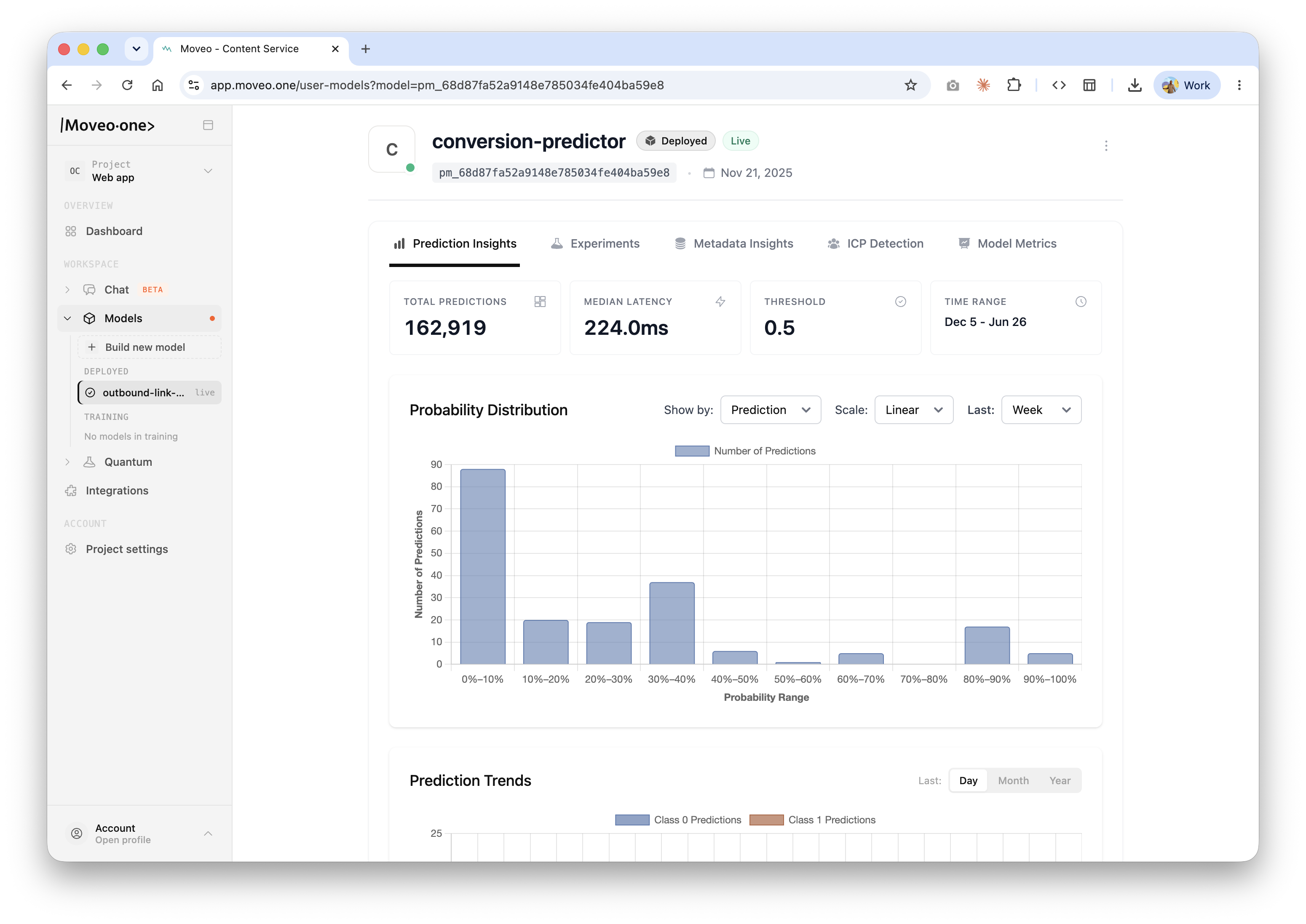
To build a predictive model that improves conversion, you train a model on your real in-product behavior and score each session's likelihood to convert while it is still happening, so you can act on hesitation before the sale is lost instead of reading about it in a funnel report. Moveo One is a predictive behavioral intelligence platform that does exactly this: you pick the outcome you care about, it trains on your historical events, and it returns a calibrated per-session conversion score in runtime — no data-science team and no model plumbing required.
How to build a predictive model that improves conversion
Conversion rarely fails at a single step; it decays through hesitation. A user lingers on the checkout screen, scrolls back to re-read shipping, stalls on payment. Classic analytics record the abandonment after it happens, when the only thing left to do is send a win-back email. A predictive model trained on your own event stream learns the leading signals — the behavior that separated the users who bought from the users who dropped — and projects them forward onto every live session.
Moveo One turns that into a per-session prediction score: a calibrated probability that this specific user will complete the outcome you defined, refreshed as the session unfolds. Calibrated means the number is honest — a session scored 0.8 corresponds to roughly eight in ten such sessions converting — so you can set an action threshold and trust it rather than treating the score as a vague hunch. In one deployment the model detected, with over 80% precision at the moment the user landed on checkout, whether a cart would convert or be abandoned.
From event to real-time score, without a data team
Building the model does not require ML expertise. You:
- Choose a target event, like
checkout_completed. - Add a condition (optional), like
cart_contains_items, so the model only scores sessions where the prediction is meaningful. - Set an A/B split (optional) to measure the real uplift of acting on the score.
- Click Build.
The model trains on your historical behavior and deploys automatically, returning a real-time probability for every qualifying session over an API or SDK with latency under ~100 ms. Because it is optimized for precision at the decision point, when it says "this user will convert" it is right about eight times out of ten — low enough false positives that it is safe to wire the score directly to discounts, support nudges, or UI changes. This is the Predict pillar in practice, and it pairs naturally with how to increase conversion rate and AI paywall optimization, where the score decides who to act on.
Why Moveo One
Moveo One builds a calibrated, explainable conversion model from your real behavior and serves it in runtime, so your product acts on intent at the exact moment it can still change the outcome. Every score arrives with the behavioral reason behind it and updates live, and the built-in A/B split proves the uplift rather than assuming it. It predicts outcomes in real time to increase conversion across an e-commerce store, a web application, a subscription product, or an AI product — using the analytics you already collect or its own SDKs. To test a change before it is even live, see how to test a feature before launching.
In practice: recovering checkouts before they're lost
An e-commerce team was losing carts at checkout and only finding out from next-day funnel numbers. They built a Moveo One model on checkout_completed, conditioned on carts that contained items, and started scoring sessions the instant users reached the checkout screen. The high-risk sessions — users hesitating, scrolling back, stalling on payment — surfaced live with the driving reason attached. Instead of blasting every cart with a blanket discount, they triggered a targeted incentive only for the on-the-fence cohort and left the already-committed buyers alone, recovering sales without eroding margin on customers who would have paid anyway.
Frequently asked questions
How do I build a predictive model in Moveo One?
You choose a target event (like checkout_completed), optionally add a condition and an A/B split, and click Build. Moveo One trains on your historical behavioral data and deploys the model automatically, returning a calibrated real-time conversion score for every qualifying session over an API or SDK.
Do I need a data scientist to build a conversion model?
No. There is no feature engineering, model selection, or MLOps to manage — you select the outcome and Moveo One handles training, deployment, monitoring, and retraining. The output is a calibrated probability you can act on directly.
How accurate are the predictions?
The models are optimized for precision at the decision point. In production deployments Moveo One has scored checkout outcomes with over 80% precision at the moment the user reaches checkout, with calibrated probabilities so a 0.8 score means roughly 80% of such sessions convert.
How do I act on a conversion score in real time?
Query the score over the API or SDK (latency under ~100 ms) and branch on it: show or hold an incentive, nudge support, adjust UI friction, or feed the signal into an agent workflow. Pairing it with the built-in A/B split lets you measure the true uplift of acting.
Keep exploring: how to increase conversion rate · predict trial conversion · browse all use cases
Keep exploring
Related use cases
Customer Churn Prediction: Score Every User Before They Leave
Customer churn prediction done right: Moveo One scores every user's calibrated probability to churn — plus the reason why — so you intervene before they leave.
How to Increase Conversion Rate by Predicting Who Will Convert
How to increase conversion rate without guesswork: Moveo One scores every user's probability to convert in real time, so you act on the people actually ready to buy.
AI Paywall Optimization: Match the Paywall to User Intent
AI paywall optimization predicts each user's intent at session start, so you serve a soft paywall to explorers and a hard paywall to high-intent users — not one rule for all.