How to Find Why Users Churn — The Reason, Not the Score
How to find why users churn: Moveo One returns the reason behind each churn prediction — UX friction, price, missing feature, weak support — so you fix the cause, not the symptom.

For Product Manager
Role-focused use case
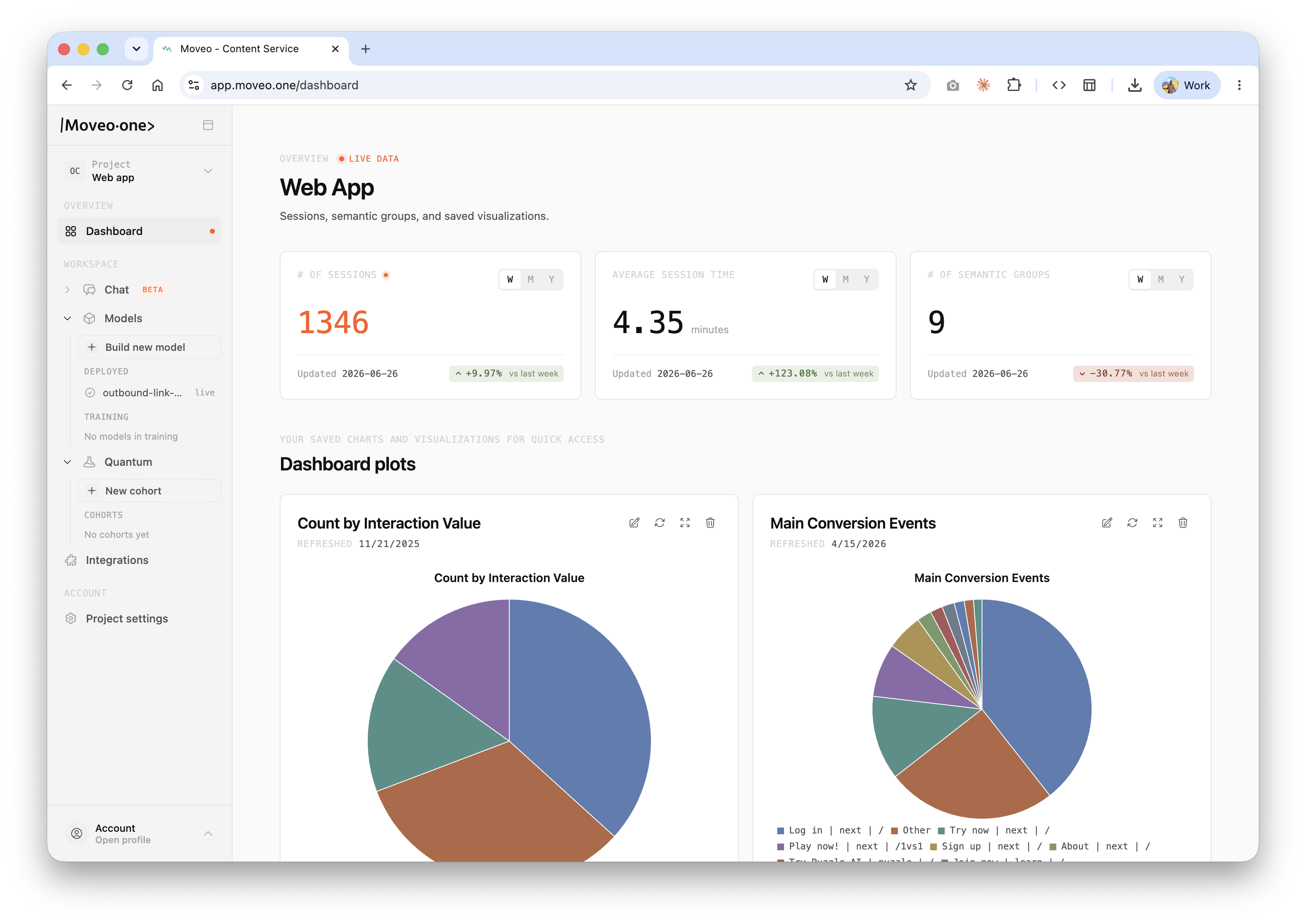
To find why users churn, you have to move past the churn rate and identify the specific reason each at-risk user is leaving — friction in a flow, price, a missing feature, or weak support. Moveo One is a predictive behavioral intelligence platform built around that reason. It doesn't just score who is about to churn; it returns the reason behind each prediction, so the fix targets the cause instead of the symptom. A churn percentage tells you something is wrong. The reason tells you what to do about it.
Why users churn analysis usually stalls
Most churn work stops at a number. A dashboard shows the rate climbed from 4% to 6%, and the team is left to theorize. Was it pricing? Onboarding? A buggy release? Without attribution, why users churn analysis becomes a guessing game where every department blames a different cause and the actual driver stays hidden. Surveys help a little, but they capture the users willing to answer — rarely the ones already halfway out the door.
The deeper problem is that the churn score and the churn reason are different things. A model can be highly accurate at predicting who will leave and still tell you nothing about why. Acting on the score alone — blasting discounts at everyone flagged as at-risk — treats wildly different problems with the same blunt instrument. The user leaving over a missing integration doesn't need a coupon.
Attributing the reason for churn
Finding the reason for churn means tying each prediction back to the behavioral signals that produced it. This is the Explain pillar: rather than reporting a symptom, Moveo One surfaces which attributes and behaviors drive the outcome. Through Metadata Insights it ranks which attributes — platform, plan, referrer, language, tenure — carry the most weight for a metric, and through ICP Detection it shows which segments are most and least at risk. For an individual user, the churn score arrives with the behavioral reasons behind it, so you can read churn as a cause rather than a coincidence.
That reframes the work. Instead of "6% of users churned this month," you get "at-risk users disproportionately share one friction point in a single flow." One of those statements is a number to worry about; the other is a task. If you also want the forward-looking score that pairs with the reason, customer churn prediction covers how the prediction itself is built, and the broader top predictive analytics platform for SaaS churn forecasting shows where it fits.
Why Moveo One
Moveo One doesn't just score churn — it returns the reason behind each prediction (UX friction, price, missing feature, weak support) so you fix the cause, not the symptom. Because the reason is grounded in real behavioral attributes rather than a survey sample, the action it points to is specific: rework a confusing step, revisit a pricing tier, ship the missing capability, or strengthen support for the segment that needs it. You can see the full set of outcomes this drives under understand the why, and how it applies to a subscription product in particular.
In practice: one friction point, hiding in plain sight
Churn looked random until Moveo One attributed it. The rate was creeping up, but the canceling users didn't share an obvious plan, region, or cohort — by every surface-level cut, the loss looked like noise. Once each prediction was tied to its behavioral reason, the pattern resolved: most at-risk users shared a single friction point in one flow. It wasn't price and it wasn't a missing feature — it was a step that quietly stalled a specific kind of user. The team fixed that one flow, and the churn that had looked unpredictable turned out to have a single, addressable cause.
Frequently asked questions
How do I find the reason a specific user churned?
Tie the churn prediction back to the behavioral signals that produced it. Moveo One returns each prediction with the reasons behind it — the attributes and in-product behaviors that drove the score — so you can see whether a given user is leaving over friction, price, a missing feature, or support, rather than guessing from the rate alone.
Isn't a churn prediction score enough to act on?
No. A score tells you who is likely to leave but not why, and different reasons call for different fixes. Acting on the score alone leads to blunt responses like discounting everyone at risk. The reason behind the prediction is what makes the intervention specific and effective.
How is this different from sending a churn survey?
Surveys capture only the users willing to respond, usually a small and biased slice, and they rely on self-reported memory. Attributing churn from behavioral data covers every at-risk user and reflects what they actually did in the product, which is why the pattern it surfaces is more reliable than survey sentiment.
Keep exploring: AI paywall optimization · analytics platform for tracking activation metrics · browse all use cases
Keep exploring
Related use cases
Improving UX During Onboarding
How to improve onboarding UX: Moveo One reads the behavior new users can't articulate — false clicks, attention decay, autopilot tapping — and points to the exact screens to fix, no manual tagging required.
Same Analytics Everywhere — Derive Consistent Conclusions Across All Platforms
How to get consistent analytics across platforms: Moveo One unifies iOS, Android, and web behavior into one model-level layer, so Flutter, React Native, and MAUI apps produce comparable conclusions instead of drifting dashboards.
Customer Churn Prediction: Score Every User Before They Leave
Customer churn prediction done right: Moveo One scores every user's calibrated probability to churn — plus the reason why — so you intervene before they leave.