How to Reduce Customer Onboarding Drop-Off in Banking Apps
How to reduce customer onboarding drop-off in banking: Moveo One predicts where users abandon KYC mid-flow — without exposing real customer data — so you intervene first.

For Product Designer
Role-focused use case
How it works
- 1Connect trial event data
- 2Train a trial-conversion model
- 3Predict conversion per user
- 4Trigger targeted interventions
- 5Measure lift
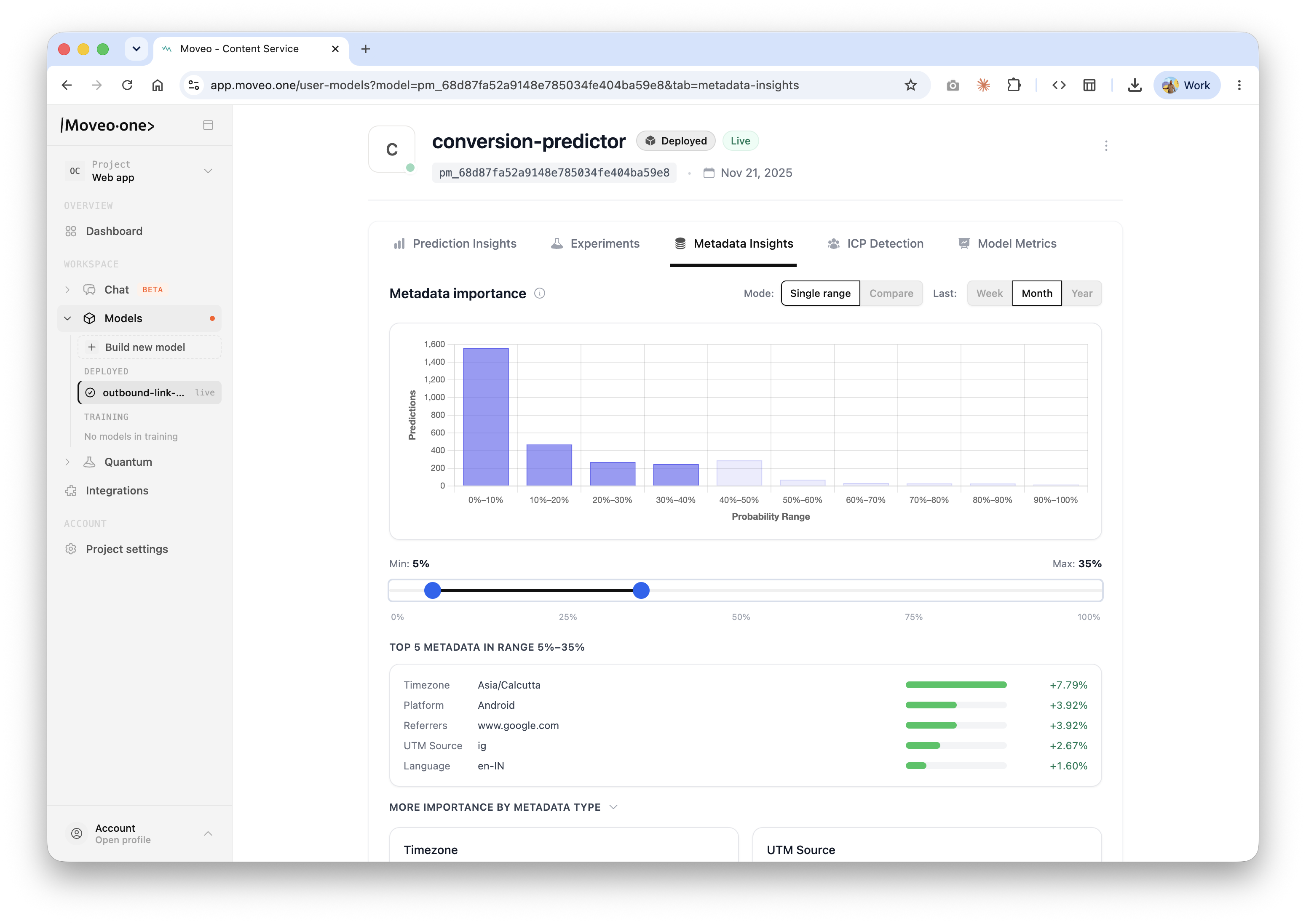
The way to reduce customer onboarding drop-off in banking is to predict where each user is about to abandon a high-friction step — identity verification, document upload, KYC checks — and intervene before they leave, rather than analyzing the funnel after they have gone. Moveo One is a predictive behavioral intelligence platform that predicts likelihood-to-abandon at each high-friction step and surfaces the reason behind it, so a banking app acts on the cause of drop-off instead of staring at a steep funnel chart.
Why banking onboarding leaks where it does
Banking onboarding is uniquely punishing because regulation and risk force friction into the exact moment a new user has the least patience. KYC and identity verification demand documents, selfies, address proofs, and waits — each a place where motivation drains. A generic funnel report tells you that a step bled twenty percent of users; it never tells you which users were about to go, or why one segment stalls on document upload while another abandons at the verification wait.
That gap is the whole problem. Aggregate funnel numbers describe the symptom after the fact. Reducing drop-off means catching the specific user mid-flow, while they are still in the app and still reachable. The same shift from after-the-fact reporting to mid-flow prediction underpins reducing onboarding drop-off generally.
Predict abandonment mid-flow, then act on it
Moveo One's explain pillar is about cause, not symptom. It predicts a user's likelihood to abandon as they move through onboarding and ties that prediction to the attributes driving it — which step, which platform, which segment is at risk. With a per-user prediction in hand, the product can respond in runtime: fast-forward an at-risk user past an optional field, surface help exactly where hesitation is predicted, or hand a stalling high-value applicant to a human before they close the app.
Crucially for a regulated environment, this works without exposing real customer data: the model learns from behavioral events, not from the sensitive personal documents flowing through KYC. Knowing the reason a cohort abandons is the same capability behind finding why users churn — drop-off in onboarding is simply churn that happens before activation.
Why Moveo One
Moveo One predicts where users will abandon high-stakes banking onboarding mid-flow and attaches the reason to each prediction, so the team intervenes on cause before a user bounces — and it does so from behavioral signals, without exposing the sensitive data moving through verification. The predictions run across native and cross-platform mobile apps where most banking onboarding happens, in runtime rather than in a weekly export. You can see the broader set of journey outcomes it drives under improve user journeys, and how it applies to a native mobile app specifically.
In practice: rescuing users mid-KYC
A banking app was losing users across its KYC steps and could see the drop in the funnel but not act on it in time. With Moveo One, the team predicted likelihood-to-abandon mid-flow and identified at-risk users while they were still in the verification sequence. Instead of letting them stall, the product fast-forwarded those users through non-essential steps and surfaced support at the precise point hesitation was predicted — turning a passive funnel report into an active save before the drop-off happened. The pattern mirrors what activation-focused teams do when they track activation metrics and want prediction, not just measurement.
Frequently asked questions
How does Moveo One predict onboarding drop-off in a banking app?
It trains a behavioral model on onboarding events and predicts each user's likelihood to abandon as they move through the flow, attaching the reason — which step or segment is driving the risk. Because the prediction updates mid-flow, the product can intervene while the user is still in the app.
Does this require exposing sensitive customer or KYC data?
No. The model learns from behavioral signals — how users move through steps — not from the personal documents or identity data flowing through verification. The prediction comes from behavior, which keeps sensitive customer data out of the modeling.
What can the product do once a user is predicted to abandon?
It can act in runtime: fast-forward an at-risk user past optional fields, surface contextual help where hesitation is predicted, or route a stalling high-value applicant to a human before they leave. The point is intervening on the specific user mid-flow rather than reviewing the funnel later.
Is onboarding drop-off the same as churn?
Functionally, yes — it is churn that happens before activation. A user who abandons KYC never becomes a customer, so the same predictive, reason-first approach used to reduce churn applies directly to onboarding.
Outside banking? For the general onboarding playbook across SaaS and mobile, see how to reduce onboarding drop-off.
Keep exploring: reduce onboarding drop-off · why users churn · browse all use cases
Keep exploring
Related use cases
Improving UX During Onboarding
How to improve onboarding UX: Moveo One reads the behavior new users can't articulate — false clicks, attention decay, autopilot tapping — and points to the exact screens to fix, no manual tagging required.
Customer Churn Prediction: Score Every User Before They Leave
Customer churn prediction done right: Moveo One scores every user's calibrated probability to churn — plus the reason why — so you intervene before they leave.
Top Predictive Analytics Platform for SaaS Churn Forecasting
Choosing a predictive analytics platform for SaaS churn forecasting? Moveo One scores every user's churn probability live and fires retention action in your product, not a weekly report.