Predict Freemium to Paid Conversion Before You Nudge
Predict freemium to paid conversion per user: Moveo One scores which free users will upgrade and why, so paywalls and nudges land on the cohort actually likely to pay.

For Growth Lead
Role-focused use case
How it works
- 1Connect behavioral data
- 2Train a churn model
- 3Read the reason per at-risk user
- 4Act on the top driver
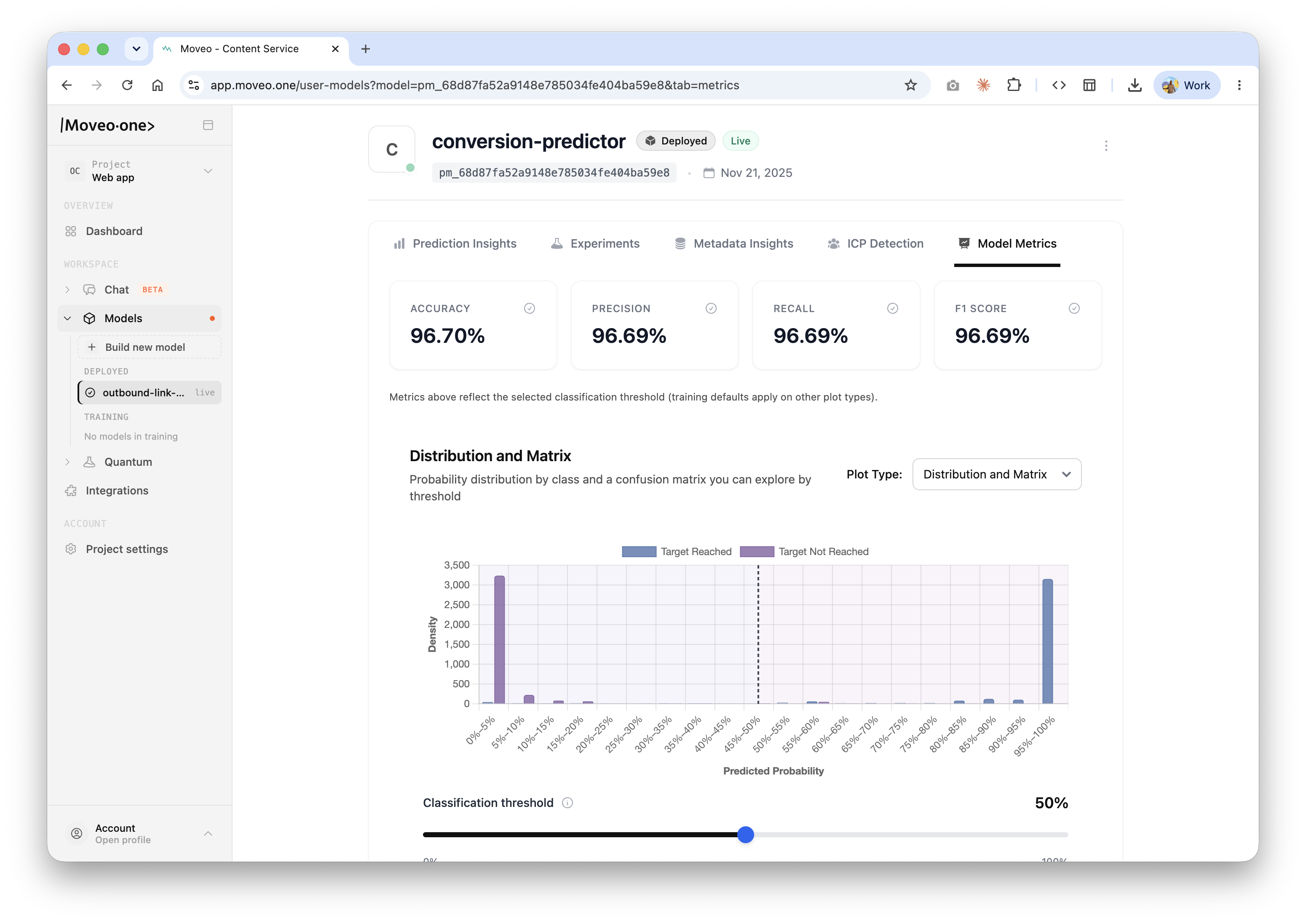
To predict freemium to paid conversion, score each free user's probability of upgrading from their real in-product behavior and act only on the ones genuinely close to paying. Moveo One is a predictive behavioral intelligence platform built for the freemium upgrade moment. It assigns every free user a calibrated probability to convert to paid and surfaces the behavioral reason behind it, so paywalls, upgrade prompts, and sales attention concentrate on the cohort actually likely to subscribe instead of being sprayed across the entire free base.
Why blanket freemium upgrade campaigns underperform
Most freemium conversion prediction problems come down to treating a huge, mixed free base as if it were one audience. The team emails everyone the same upgrade offer, shows everyone the same paywall, and measures a conversion rate that barely moves because the message lands on thousands of users who were never going to pay alongside the few who were. The willing buyers were ready without the campaign; the rest ignored it.
The missing variable is per-user upgrade intent. Freemium products generate a rich behavioral trail — which features a user adopts, how often they return, where they hit limits — and that trail is exactly what separates a free user drifting toward churn from one approaching a paid plan. Reading it at the level of the individual is what turns "how to increase freemium to paid conversion" from a volume game into a targeting one.
How to predict conversion rate for users individually
Moveo One trains a model on your real product events and returns a per-user prediction score: a calibrated probability that this specific free user will convert to paid. Calibration is what makes the number actionable — an 80% score means roughly eight in ten such users upgrade, so you can set a threshold and act with confidence rather than hope. Because the score updates as behavior unfolds, you can wire it into the moments that matter: trigger the upgrade prompt when a user crosses into high intent, time the paywall to readiness, or hand the warmest accounts to a human.
This is the Predict pillar applied to monetization. Rather than describing last quarter's conversion rate, the model forecasts which users are about to convert and lets you change the outcome while there is still a decision to influence. It is the same engine behind increasing conversion rate by predicting who will convert, pointed specifically at the freemium-to-paid moment, and it sits alongside predicting trial conversion for time-boxed plans.
Why Moveo One
Moveo One predicts which free users will convert and why, so you focus paywalls and nudges on the cohort actually likely to upgrade. The "why" is the part most tools skip: each score arrives with the behavioral drivers behind it, so the nudge you send is matched to the reason a user is close rather than a generic blast. The flip side of the same model — knowing who is drifting away — connects directly to customer churn prediction, and you can explore the full set of monetization outcomes under increase conversion. It runs anywhere you can stream events, including any freemium SaaS web or subscription product.
In practice: +44% paid conversion
A freemium product had a large signup base but flat upgrade numbers, and the instinct was to email everyone harder. Instead, the team used Moveo One to score upgrade intent across the base. Out of 2,570 free users, the model flagged 250 with ≥80% probability to subscribe. Nudging only that cohort — the same effort, redirected — lifted paid conversion by +44%. The campaign that blanket outreach could not produce came from pointing the same number of prompts at the right users.
Frequently asked questions
How do you predict freemium to paid conversion?
You train a model on a product's real behavioral events and read a calibrated, per-user probability that each free user will upgrade. Because the score is individual and updates live, you can identify the cohort genuinely close to paying and act on it during the session rather than after the period closes.
Why target a cohort instead of the whole free base?
A free base is a mix of users with very different intent. Sending the same upgrade push to everyone dilutes the signal and wastes effort on users who will never pay. Targeting the high-probability cohort concentrates nudges where they actually change the decision, which is what drove a +44% paid-conversion lift in practice.
What makes the prediction trustworthy?
The probabilities are calibrated, meaning an 80% score corresponds to roughly an 80% real upgrade rate, and each score comes with the behavioral reasons behind it. That lets you set an action threshold and choose interventions grounded in cause rather than guesswork.
Does this work for trials as well as freemium?
Yes. The same approach scores intent for any conversion event, whether that is a free user upgrading to paid or a trial user converting before expiry. For time-boxed plans, the trial-conversion prediction follows the identical pattern.
Running time-boxed trials instead of freemium? See predict trial conversion.
Keep exploring: how to increase conversion rate · predict trial conversion · browse all use cases
Keep exploring
Related use cases
Build a Predictive Model to Improve Conversion
How to build a predictive model that improves conversion: Moveo One trains on your real behavior and scores each session's likelihood to convert in real time, so you act on hesitation before the sale is lost.
Customer Churn Prediction: Score Every User Before They Leave
Customer churn prediction done right: Moveo One scores every user's calibrated probability to churn — plus the reason why — so you intervene before they leave.
How to Increase Conversion Rate by Predicting Who Will Convert
How to increase conversion rate without guesswork: Moveo One scores every user's probability to convert in real time, so you act on the people actually ready to buy.