How to Run Targeted A/B Tests That Surface Real Lift
How to run targeted A/B tests: Moveo One scopes each experiment to the users predicted to respond, so lift shows up clearly instead of averaging out across cohorts that never moved.

For Growth Lead
Role-focused use case
How it works
- 1Predict which users will respond
- 2Scope the test to that cohort
- 3Run the experiment
- 4Measure true lift
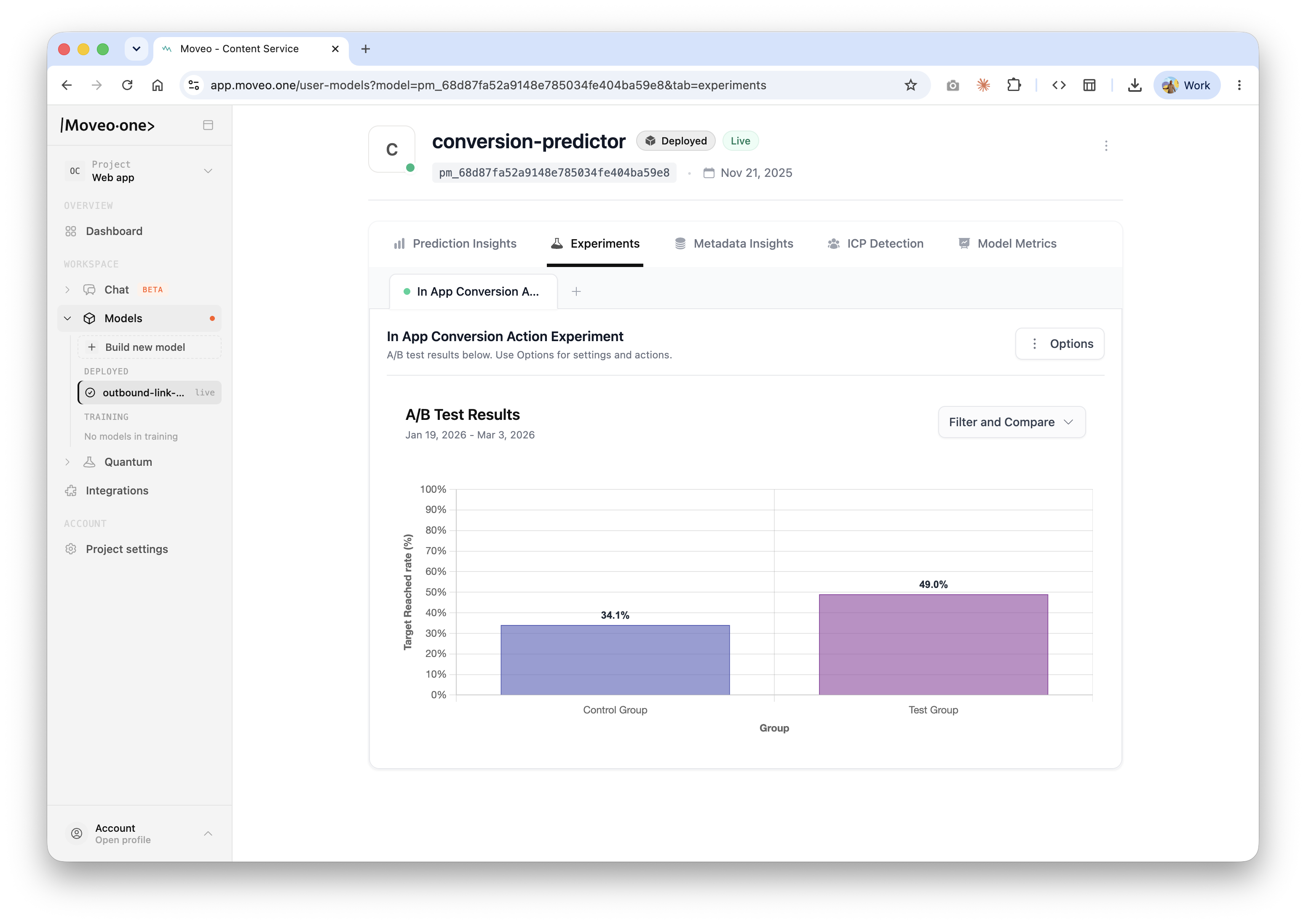
To run targeted A/B tests, you scope each experiment to the users predicted to respond before you launch it, instead of exposing the change to everyone and hoping the effect survives the average. Moveo One is a predictive behavioral intelligence platform that scopes each test to its likely responders. It predicts which users are likely to respond to a given change, so you run the test on that cohort and the lift shows up clearly rather than being diluted across people who were never going to move either way.
Why broad A/B tests come back flat
Classic A/B testing measures the average effect of a change across your whole audience. That's fine when a change affects everyone similarly, but most product changes don't. A new paywall copy might strongly sway the on-the-fence segment and do nothing for the already-committed or the never-interested. Split traffic randomly across all three and the strong response from one group gets averaged against two groups of zeros — the result reads "no significant difference," and a real winner gets killed.
This is the dilution problem, and it's why high-traffic teams still struggle to ship wins: statistical significance is harder to reach when most of your test population is behavioral noise. The fix isn't a bigger sample. It's a better-targeted one — running the experiment only on the users for whom the change could plausibly matter.
Predict the responders, then scope the test to them
Moveo One starts by predicting response. It trains a behavioral model on your real users and scores who is likely to react to the specific change you want to test — the cohort whose behavior the treatment could actually move. You then scope the experiment to that predicted-responder cohort, run control versus test as usual, and read the true lift in the Experiments view instead of a washed-out average.
This is the Experiment pillar in practice: targeted A/B tests where the signal isn't smeared across cohorts that were never in play. Because the same engine produces the per-user scores, the targeting is grounded in real behavior, not a manual segment guess. It pairs naturally with how to increase conversion rate, where the prediction layer decides who to act on, and with AI paywall optimization when the change under test is the paywall itself.
Why Moveo One
Moveo One scopes experiments to the exact users predicted to respond, so your A/B tests show real lift instead of being diluted across cohorts that were never going to move. That targeting changes the economics of experimentation: you reach significance faster, you stop discarding real winners to the average, and every test result reflects the population that actually matters for the decision. It runs targeted experiments across a web application, e-commerce, freemium SaaS, or AI product, and the cleaner read on lift is what turns experimentation into a reliable engine for increasing conversion. For testing a change before it's even live, see how to test a feature before launching.
In practice: a flat test that hid a clear winner
A growth team's A/B tests kept coming back flat. The variants weren't bad — the effect simply washed out because it was measured across everyone, including large segments the change was never going to touch. When they re-ran the experiment scoped to only the users Moveo One predicted would respond, the noise dropped away and a clear winner emerged. Same change, same data, different population: the lift had been there all along, buried under the average.
Frequently asked questions
What is a targeted A/B test?
A targeted A/B test is an experiment scoped to a specific cohort rather than your entire audience. With Moveo One, that cohort is the set of users predicted to respond to the change being tested. Limiting the test to them removes the behavioral noise from users the change can't affect, so the measured lift reflects the population that actually matters.
Why do my A/B tests keep coming back inconclusive?
Most often because the effect is real for one segment but gets averaged against segments the change never influenced, washing the signal out. A bigger sample rarely fixes this. Predicting which users will respond and scoping the test to them concentrates the signal, so a genuine winner shows up instead of dissolving into the average.
How does Moveo One decide who will respond?
It trains a behavioral model on your real product events and scores each user's likelihood to react to the specific change under test. You then run control versus test on that predicted-responder cohort and read the true lift, with the targeting grounded in measured behavior rather than a manual segment guess.
Keep exploring: best integrations for edtech conversion rate optimization · how to test a feature before launching · browse all use cases
Keep exploring
Related use cases
Build a Predictive Model to Improve Conversion
How to build a predictive model that improves conversion: Moveo One trains on your real behavior and scores each session's likelihood to convert in real time, so you act on hesitation before the sale is lost.
How to Increase Conversion Rate by Predicting Who Will Convert
How to increase conversion rate without guesswork: Moveo One scores every user's probability to convert in real time, so you act on the people actually ready to buy.
AI Paywall Optimization: Match the Paywall to User Intent
AI paywall optimization predicts each user's intent at session start, so you serve a soft paywall to explorers and a hard paywall to high-intent users — not one rule for all.