How to Test a Feature Before Launching with Synthetic Users
How to test a feature before launching: Moveo One simulates synthetic users calibrated to your real cohorts against the change, so you see how each segment responds before release.

For Developer
Role-focused use case
How it works
- 1Connect funnel data
- 2Predict intent per session
- 3Route users to soft or hard paywall
- 4Measure revenue per signup
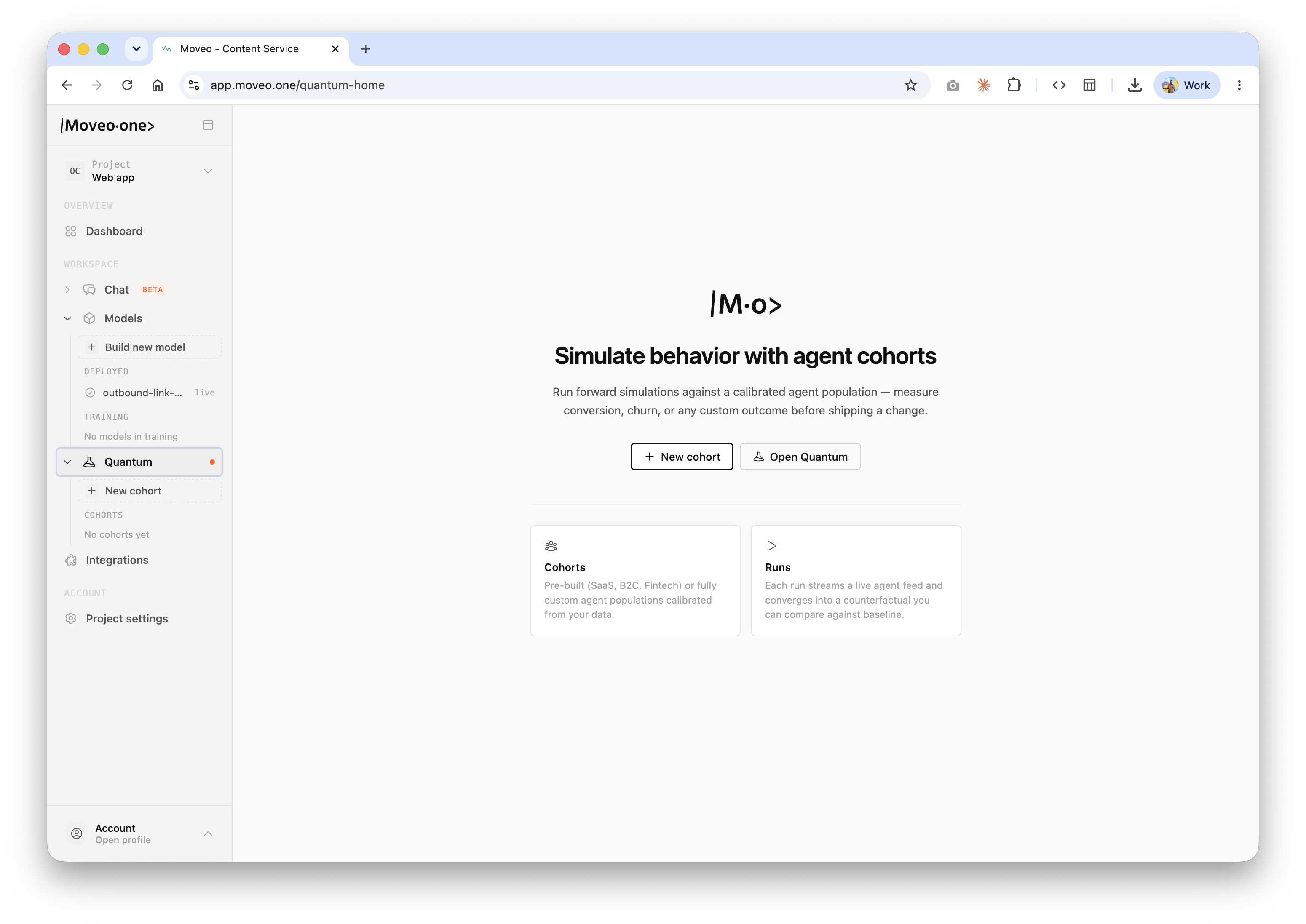
To test a feature before launching, you simulate how real user segments will behave against the change and read the result before a single live user touches it. Moveo One is a predictive behavioral intelligence platform that can run your product forward before you ship it. Its Quantum simulation runs forward against a population of synthetic users calibrated to your real behavioral cohorts, so you can see how each segment responds to a new onboarding step, paywall, or redesign and fix the weak point before release instead of after.
Simulate before you ship
The honest problem with a pre-launch decision is that you only learn the truth after you ship — when the cohort you guessed wrong about is already churning. Learning how to simulate user behavior changes that order of operations. Instead of reasoning from a mockup, you run the proposed flow against agents that move the way your actual users move, and each run converges into a counterfactual against your current baseline: agents are marked converted or bounced, and you can read where they fall off.
This matters most for the changes that are expensive to reverse. When you want to test a paywall before launch, simulate the paywall impact across segments and see which cohorts hit the wall and abandon versus which convert through it. When you test a redesign before shipping, simulate the redesign and watch whether the new path holds intent or quietly leaks it mid-funnel. The output is a forecast you can act on, not an opinion you have to defend.
Calibrated agents, not generated personas
The credibility of a simulation lives entirely in who the agents are. Moveo One's synthetic users are calibrated to your real behavioral cohorts — derived from how your users actually behave — not personas typed into a prompt. That is what separates this from a thought experiment: the population converging through your new flow reflects your data, so the drop-off it surfaces is one you would have seen for real. This is the same engine behind agentic AI software testing, and it is worth understanding what synthetic users are before you rely on a result.
Because the simulation produces segment-level outcomes, it also tells you where a targeted experiment is worth running once you do launch — pairing naturally with how to run targeted A/B tests on the live cohorts predicted to respond.
Why Moveo One
Moveo One points synthetic users calibrated to your real cohorts at any new feature, so you see how each segment responds before a single live user touches it. The agents are grounded in your behavior rather than invented, each run gives you a converted-versus-bounced breakdown against baseline, and the whole exercise happens off your live traffic — meaning a bad launch is caught in simulation, not in your churn numbers. You can explore the broader workflow under test before you launch and how it applies to a web application.
In practice: catching an 18% drop before release
Ahead of a launch, a team simulated a new onboarding step rather than rolling it out and watching the funnel. The run showed mid-funnel agents dropping 18% before activation — a leak that would have shown up as flat activation and a confusing week of debugging if it had gone live. Because the result arrived in simulation, the team reworked the step and fixed the drop before release instead of after, turning a post-mortem into a pre-launch correction.
Frequently asked questions
How does Moveo One test a feature before launching?
It runs a forward simulation of the proposed feature against synthetic users calibrated to your real cohorts. Each run converges into a counterfactual versus your current baseline, marking agents converted or bounced, so you can read how each segment responds and fix problems before the feature reaches live users.
Are synthetic users the same as personas?
No. Personas are descriptions someone writes. Synthetic users in Moveo One are agents calibrated to your real behavioral cohorts, derived from how your users actually behave, which is why the simulated drop-off corresponds to outcomes you would see in production.
Can I simulate a paywall or redesign specifically?
Yes. You can simulate paywall impact across segments to see which cohorts abandon versus convert, and simulate a redesign to check whether the new path preserves intent. These are common pre-launch decisions where shipping first is costly to undo.
Does the simulation touch my live users?
No. The simulation runs against the calibrated agent population, not your production traffic, so you get the forecast without exposing real users to an untested change.
Keep exploring: how to increase conversion rate · synthetic users · browse all use cases
Keep exploring
Related use cases
Build a Predictive Model to Improve Conversion
How to build a predictive model that improves conversion: Moveo One trains on your real behavior and scores each session's likelihood to convert in real time, so you act on hesitation before the sale is lost.
How to Increase Conversion Rate by Predicting Who Will Convert
How to increase conversion rate without guesswork: Moveo One scores every user's probability to convert in real time, so you act on the people actually ready to buy.
AI Paywall Optimization: Match the Paywall to User Intent
AI paywall optimization predicts each user's intent at session start, so you serve a soft paywall to explorers and a hard paywall to high-intent users — not one rule for all.