Synthetic Users: Calibrated Behavioral Testing Before You Ship
Synthetic users in Moveo One are calibrated to your real behavioral cohorts — not prompt-generated personas — so you can test changes against users that behave like yours.

For Developer
Role-focused use case
How it works
- 1Stream events to Moveo
- 2Train a behavioral model
- 3Call the prediction API per user
- 4Wire the score to webhooks or app logic
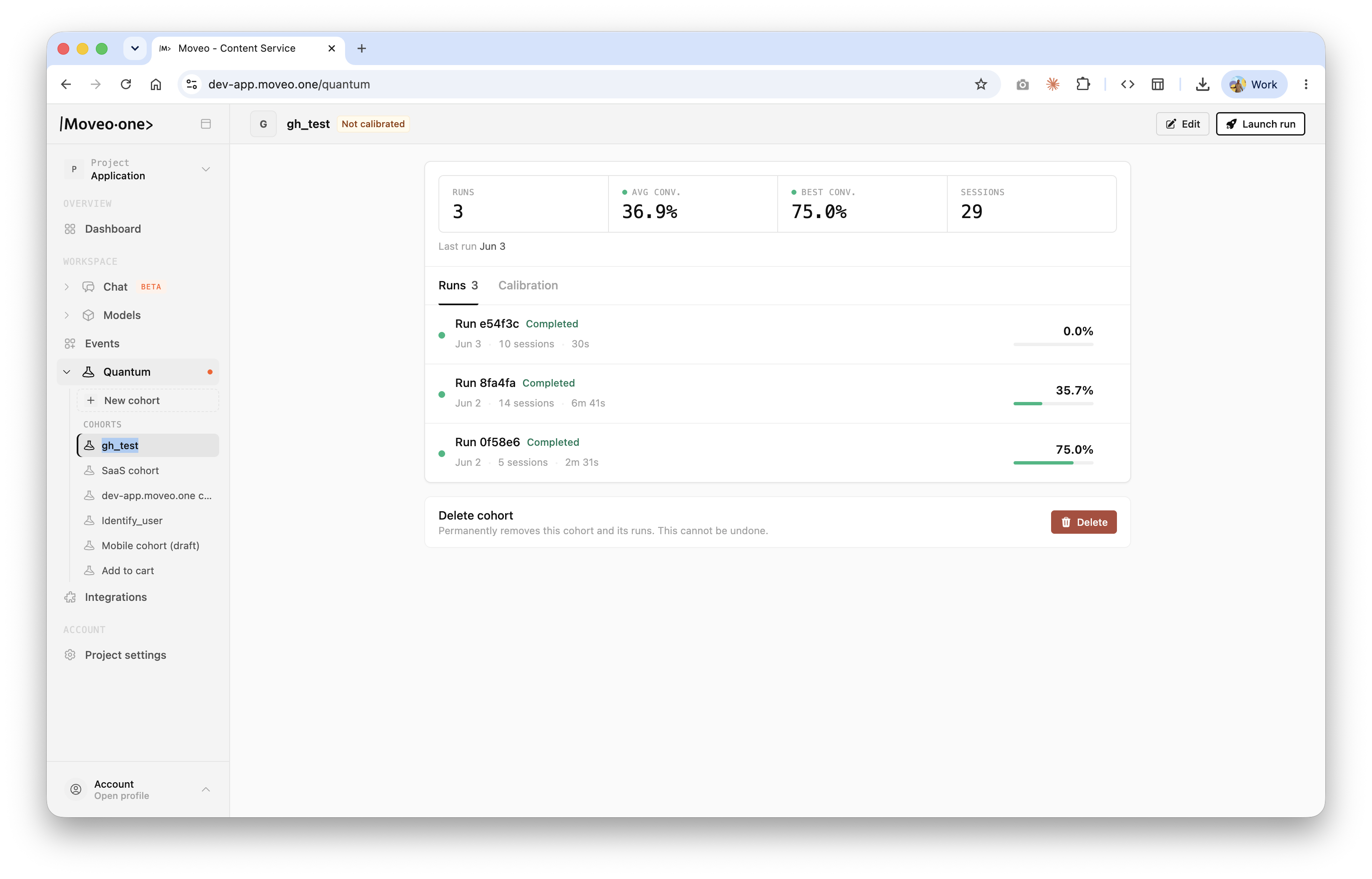
Synthetic users are simulated users calibrated to your product's real behavioral cohorts, used to run a change through a flow before any real person touches it. In Moveo One — a predictive behavioral intelligence platform for SaaS product teams — synthetic users are not personas invented from a prompt. They are agents calibrated from your actual event data, so when they move through a new screen or paywall they behave the way your real cohorts would, and the friction they hit is friction your real users would hit too.
What synthetic user testing actually is
Synthetic user testing is the practice of running a calibrated synthetic population through a proposed flow to see how it performs before launch. The value lives entirely in the word calibrated. A generic "AI persona" is a plausible-sounding character with no statistical relationship to your product; it will agree with almost any design you show it because it has nothing real to push back with. A calibrated synthetic user is grounded in how your power users, your casual users, and your at-risk users have actually behaved, so the simulation converges toward a realistic outcome instead of a flattering one.
That distinction is the difference between theater and a forecast. When people ask what is synthetic user testing and expect it to replace live experiments, the honest answer is that it does something earlier in the cycle: it tells you what is likely to break, for which cohort, before you have spent a launch finding out.
Simulate before you ship
Moveo One's simulation pillar runs your new flow against this calibrated agent population and reports where each cohort converts, hesitates, or bounces. Each run converges into a counterfactual against your current baseline, so you read the change as lift or regression rather than a single guess. A redesign that looks cleaner can quietly punish the workflow your most valuable cohort depends on — exactly the kind of regression a flat average hides and a per-cohort simulation surfaces. Once a change clears simulation, you can scope a live test to the users predicted to respond; that handoff is covered in how to test a feature before launching.
Synthetic users versus generated personas
The phrase synthetic user is now attached to two very different things. One is a prompt-generated character — useful for brainstorming copy, useless for predicting behavior. The other, the one that matters here, is a behaviorally calibrated agent. The first will tell you what sounds good; the second will tell you what your cohorts will do. This is also where calibrated synthetic simulation parts ways with agentic AI software testing: the goal is not to crawl your UI for defects but to predict human behavior through it.
Why Moveo One
Moveo One calibrates its synthetic users to your real behavioral cohorts and runs them as a forward simulation, so a change is validated against users that actually behave like yours before it ships. The same model that powers simulation returns per-user predictions over an API or SDK across web, iOS, Android, React Native, and Flutter, which means the behavioral ground truth behind your tests is the ground truth running in production. You can see the full set of pre-launch outcomes it drives under test before you launch, and how it applies to an AI product specifically.
In practice: catching a power-user regression
Before shipping a redesign, a team ran calibrated synthetic users through the new flow. The aggregate numbers looked fine — but broken out by cohort, the simulation flagged a regression hitting power users: a shortcut they relied on had moved, and their predicted completion dropped sharply. Generic AI personas, with no memory of how those users actually worked, would have sailed through the redesign and approved it. The team fixed the path before launch instead of discovering it through a wave of support tickets.
Frequently asked questions
What are synthetic users?
Synthetic users are simulated agents calibrated to your product's real behavioral cohorts. They move through a flow the way your actual users would, so you can test a change before launch and read how each cohort responds.
How is this different from AI personas generated from a prompt?
A prompt-generated persona is a plausible character with no statistical link to your product, so it tends to approve whatever you show it. A calibrated synthetic user is grounded in your real event data, so its behavior — and the friction it predicts — reflects how your cohorts genuinely act.
What is synthetic user testing used for?
It is used to validate a change before it ships: running a calibrated synthetic population through a new flow to predict where each cohort will convert, hesitate, or bounce, and to catch regressions before real users encounter them.
Does synthetic testing replace live experiments?
No. It runs earlier in the cycle. Simulation surfaces likely problems before launch; once a change clears it, you scope a live experiment to the users predicted to respond so the real lift shows up clearly.
Keep exploring: test a feature before launching · agentic AI software testing · browse all use cases
Keep exploring
Related use cases
Agentic AI Software Testing With Behavior-Calibrated Users
Agentic AI software testing predicts where real users would stall before launch. Moveo One runs behavior-calibrated synthetic users through your flow, not just code checks.
How to Code User Prediction Without Building an ML Pipeline
How to code user prediction: Moveo One trains a behavioral model on your real events and returns per-user predictions over an API, so you ship intent scores without an ML stack.
Synthetic Monitoring vs Real User Monitoring: Where Moveo Fits
Synthetic monitoring vs real user monitoring explained: one watches uptime, the other watches sessions. Moveo's calibrated synthetic users predict behavior, a different question entirely.