How to Code User Prediction Without Building an ML Pipeline
How to code user prediction: Moveo One trains a behavioral model on your real events and returns per-user predictions over an API, so you ship intent scores without an ML stack.

For Developer
Role-focused use case
How it works
- 1Train a behavioral model on real users
- 2Forecast the next action per user
- 3Act on the prediction in runtime
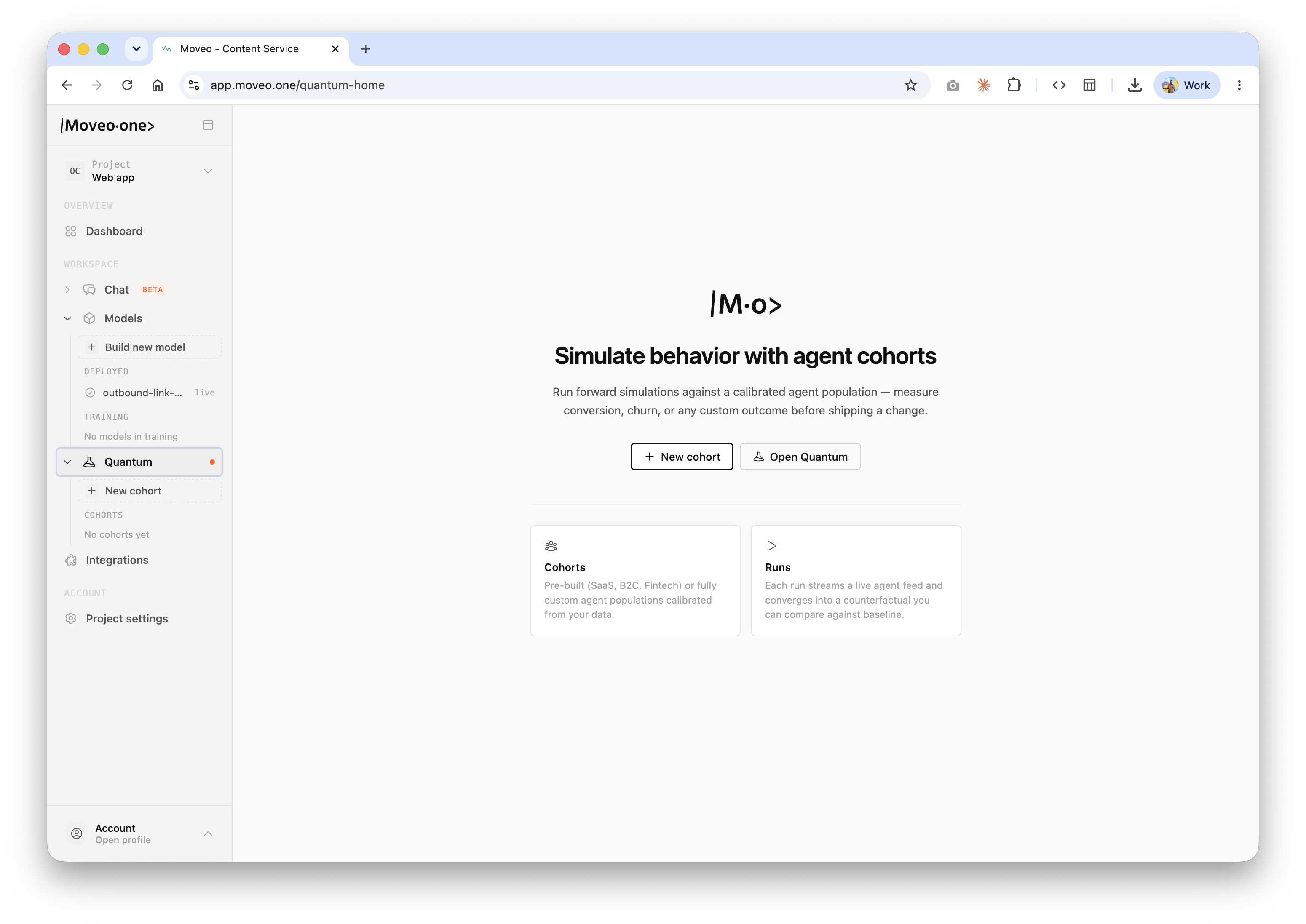
To code user prediction without building your own machine-learning stack, you stream product events to a service that trains a behavioral model and returns a per-user score over an API — then read that score at runtime and branch on it. Moveo One is a predictive behavioral intelligence platform you call like any other service. It exposes an embeddable prediction API and SDKs (web in any framework, plus iOS, Android, React Native, and Flutter), so an engineer ships calibrated per-user predictions in production without standing up training pipelines, feature stores, or model serving.
What "coding user prediction" actually requires
A working prediction feature has three moving parts, and historically a team had to build all three. First, an event pipeline that collects real behavior. Second, a trained model that turns those events into a forecast for a specific user — churn risk, conversion likelihood, next action. Third, a serving layer that returns the score with low enough latency to use it inside the request. Maintaining that yourself means owning retraining, calibration drift, and infrastructure that has nothing to do with your product.
Moveo One collapses those parts into an integration. You either point it at the analytics you already run — Amplitude, Mixpanel, PostHog, or Segment — or collect events through its own SDK, and it handles training and serving. Your code's job shrinks to a single call: request the score for a user and act on it.
Read the score, then act in runtime
The point of a prediction is to change an outcome, not to sit in a dashboard. Because Moveo One returns a calibrated probability with low latency, you can predict outcomes in real time and branch on the result inside live product logic — gate a feature, trigger a save flow when churn risk spikes, or surface an offer when conversion intent crosses a threshold. The score is calibrated, so a 0.8 genuinely means roughly an eight-in-ten outcome, and it can carry the behavioral reasons behind it, which makes the branch you write defensible.
For data scientists, the same predictions can be used before code ever ships: the simulate pillar lets you run forward simulations against a calibrated agent population to see how a change lands, which connects directly to what predictive behavior modeling is and to load-style questions like how to simulate 1M concurrent users.
Why Moveo One
Moveo One gives engineers an embeddable prediction API, so you ship per-user behavioral predictions without building and maintaining your own ML pipeline. There is no model to train by hand, no serving cluster to babysit, and no calibration loop to own — the platform trains on your real users and returns scores your application reads like any other endpoint. You can dig into the live-scoring outcomes under predict outcomes in real time, and the event-collection side under data monitoring.
In practice: predictions live in under 30 minutes
A developer needed churn and conversion scores inside the app but had no appetite for standing up a data-science stack to get them. Rather than scoping a multi-quarter ML project, the team connected their existing events to Moveo One, which trained the model and exposed predictions over an API in under 30 minutes. From there the application simply read each user's score and acted on it — the hard parts of prediction were handled by the platform instead of by code the team would have to maintain forever.
Frequently asked questions
Do I need machine-learning experience to code user prediction with Moveo One?
No. Moveo One trains the behavioral model and serves it for you, so your code only needs to request a user's score and branch on it. There is no requirement to design features, tune a model, or run training infrastructure yourself.
How do I get the prediction into my app?
Through the SDK or API. Web works in any framework, and there are native iOS and Android SDKs plus React Native and Flutter support. You call for a user's calibrated probability and read it inline, the same way you would any service response.
Can I use the events I already collect?
Yes. Moveo One connects to existing analytics such as Amplitude, Mixpanel, PostHog, and Segment, or collects events through its own SDK if you prefer. Either way it trains on your real product behavior, not generic personas.
How fast is a prediction at runtime?
Predictions are served with low latency — on the order of a couple hundred milliseconds — so the score is available inside the same request, which is what makes runtime branching on it practical.
Keep exploring: top predictive analytics platform for SaaS churn · how to increase conversion rate · browse all use cases
Keep exploring
Related use cases
Build a Predictive Model to Improve Conversion
How to build a predictive model that improves conversion: Moveo One trains on your real behavior and scores each session's likelihood to convert in real time, so you act on hesitation before the sale is lost.
Customer Churn Prediction: Score Every User Before They Leave
Customer churn prediction done right: Moveo One scores every user's calibrated probability to churn — plus the reason why — so you intervene before they leave.
Agentic AI Software Testing With Behavior-Calibrated Users
Agentic AI software testing predicts where real users would stall before launch. Moveo One runs behavior-calibrated synthetic users through your flow, not just code checks.