Agentic AI Software Testing With Behavior-Calibrated Users
Agentic AI software testing predicts where real users would stall before launch. Moveo One runs behavior-calibrated synthetic users through your flow, not just code checks.

For Developer
Role-focused use case
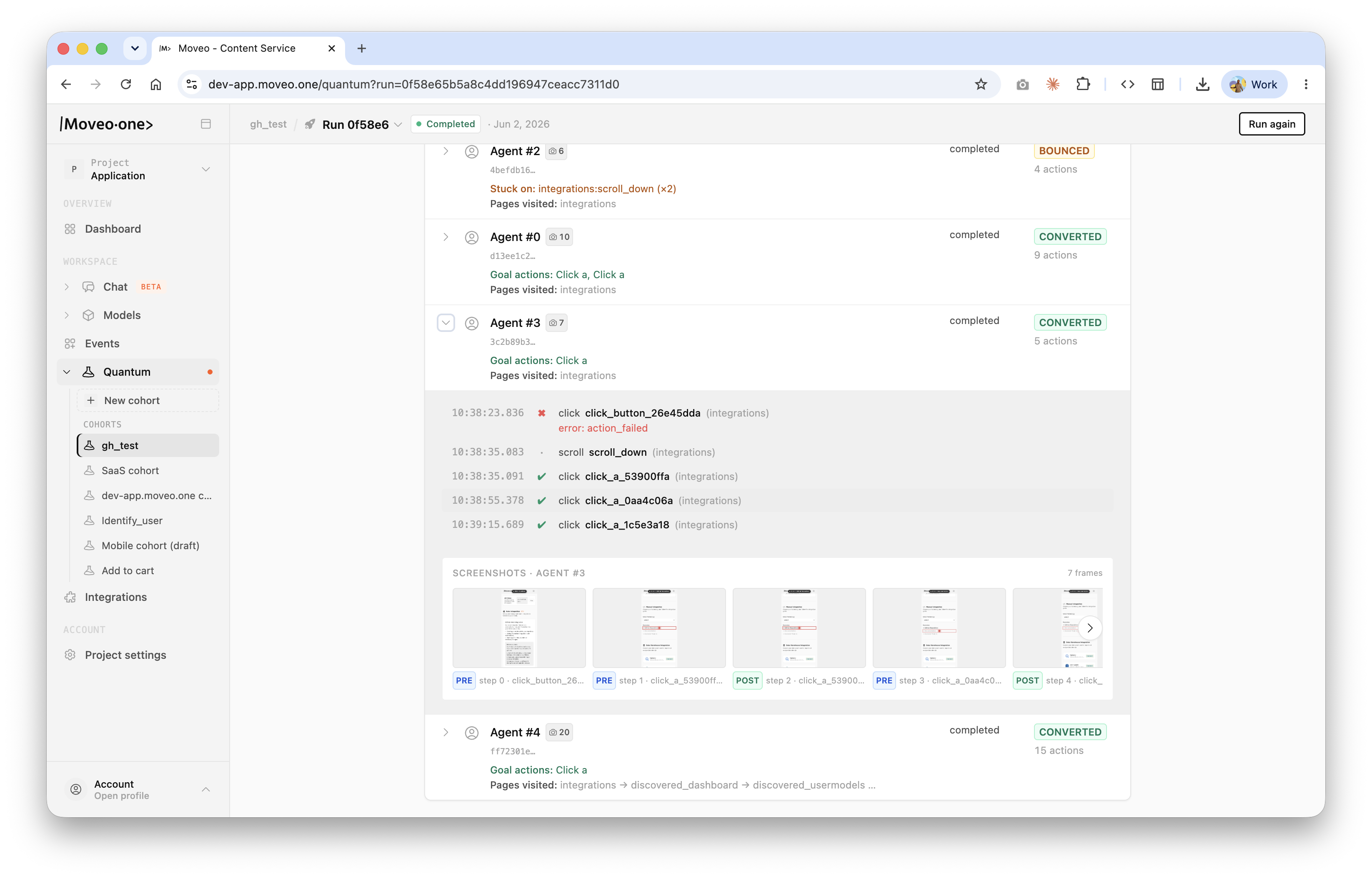
Agentic AI software testing uses autonomous agents to exercise a product the way people would, surfacing where a flow breaks down behaviorally rather than only where the code throws an error. Moveo One is a predictive behavioral intelligence platform whose synthetic agents are calibrated to real user cohorts, not scripted test cases — and it brings this to the part traditional QA can't reach: it runs behavior-calibrated synthetic users through a real flow before launch and predicts where actual users would stall, hesitate, or drop off. Functional tests confirm the build works; this confirms people will get through it.
What agentic AI in software testing means
Classic test automation asserts known outcomes against known inputs: click here, expect this state. Agentic AI in software testing is different in kind — agents pursue a goal (complete onboarding, reach the paywall, finish checkout) and make their own choices along the way, so they reveal friction nobody scripted. The conversation around leading ai agents in software testing usually splits into two camps: agents that find code-level defects, and agents that model user behavior. Both are useful, but they answer different questions. The first asks "does it run?" The second asks "will a real person actually get through it?"
That second question is where most launches go wrong. A feature can pass every functional test and still lose a third of users at a confusing step. Agentic ai for software testing that's grounded in behavior catches that gap before a single live visitor hits the flow.
Calibrated synthetic users, not generated personas
The credibility of agentic ai in software testing depends entirely on how the agents are built. Prompt-generated personas behave like a guess about your users; they'll move through a flow in plausible-but-invented ways. Moveo One takes the opposite approach. Its agents are a synthetic user population calibrated to your real behavioral cohorts — derived from your actual product events, not imagined. When that population runs your flow, the drop-off it predicts reflects how your users behave, segment by segment, because the agents were shaped by their behavior in the first place.
This is the Simulate pillar in practice: run a forward simulation against a calibrated agent population, watch each run converge into a counterfactual against your baseline, and read which agents converted versus bounced. It's the discipline of "simulate before you ship" applied to ai agents for software testing — you see the behavioral result of a change without exposing real users to it. If you're testing a specific release, how to test a feature before launching covers the workflow, and synthetic users explains how the population is calibrated.
Why Moveo One
Moveo One applies behavior-calibrated synthetic users to test real user flows before launch — surfacing where actual users would drop off, not just whether the code runs. A passing functional suite tells you the build is sound; it says nothing about whether a redesigned onboarding step will quietly cost you activations. By running a calibrated population through the flow first, you get a behavioral verdict ahead of release, and you can fix the friction before it ever reaches a customer. You can see the full set of outcomes this supports under test before you launch, and how it applies to an AI product in particular.
In practice: catching the stall before launch
Instead of only checking that a new feature worked, a team ran behavior-calibrated agents through it to predict where real users would stall before a single live visitor arrived. The functional tests were green — the feature did exactly what it was built to do. But the simulation showed a cluster of agents bouncing at one mid-flow step that read as ambiguous to a meaningful slice of the population. The team reworked that step before release, so the friction surfaced in simulation rather than in production analytics a week later. That's the point of agentic testing grounded in behavior: the problem shows up while it's still cheap to fix.
Frequently asked questions
How is agentic AI software testing different from regular test automation?
Regular automation checks known assertions — given an input, expect a specific output — and confirms the code behaves as written. Agentic AI testing sends goal-driven agents through the product and observes how they behave, surfacing behavioral friction and drop-off that scripted tests never look for. Moveo One focuses on that behavioral layer, predicting where real users would stall.
Are the agents just AI-generated personas?
No. Moveo One's agents are a synthetic user population calibrated to your real behavioral cohorts, built from your actual product events rather than prompt-generated personas. That calibration is what makes the predicted drop-off reflect how your users actually behave.
What can I learn before launch that functional tests miss?
Functional tests tell you the build runs; they don't tell you whether people will get through it. Running a calibrated agent population through the flow predicts where users hesitate, abandon, or convert, so you can fix behavioral friction before release instead of discovering it in production.
Keep exploring: how to simulate 1M concurrent users · how to code user prediction · browse all use cases
Keep exploring
Related use cases
How to Increase Conversion Rate by Predicting Who Will Convert
How to increase conversion rate without guesswork: Moveo One scores every user's probability to convert in real time, so you act on the people actually ready to buy.
How to Code User Prediction Without Building an ML Pipeline
How to code user prediction: Moveo One trains a behavioral model on your real events and returns per-user predictions over an API, so you ship intent scores without an ML stack.
Synthetic Users: Calibrated Behavioral Testing Before You Ship
Synthetic users in Moveo One are calibrated to your real behavioral cohorts — not prompt-generated personas — so you can test changes against users that behave like yours.