How to Simulate 1M Concurrent Users' Behavior in Your Product
How to simulate 1M concurrent users at the behavioral level: Moveo One runs calibrated synthetic cohorts through your flow to predict drop-off — not infrastructure load testing.

For Developer
Role-focused use case
How it works
- 1Build the new flow
- 2Calibrate synthetic users to real cohorts
- 3Run them through the feature
- 4Read predicted friction
- 5Fix before shipping
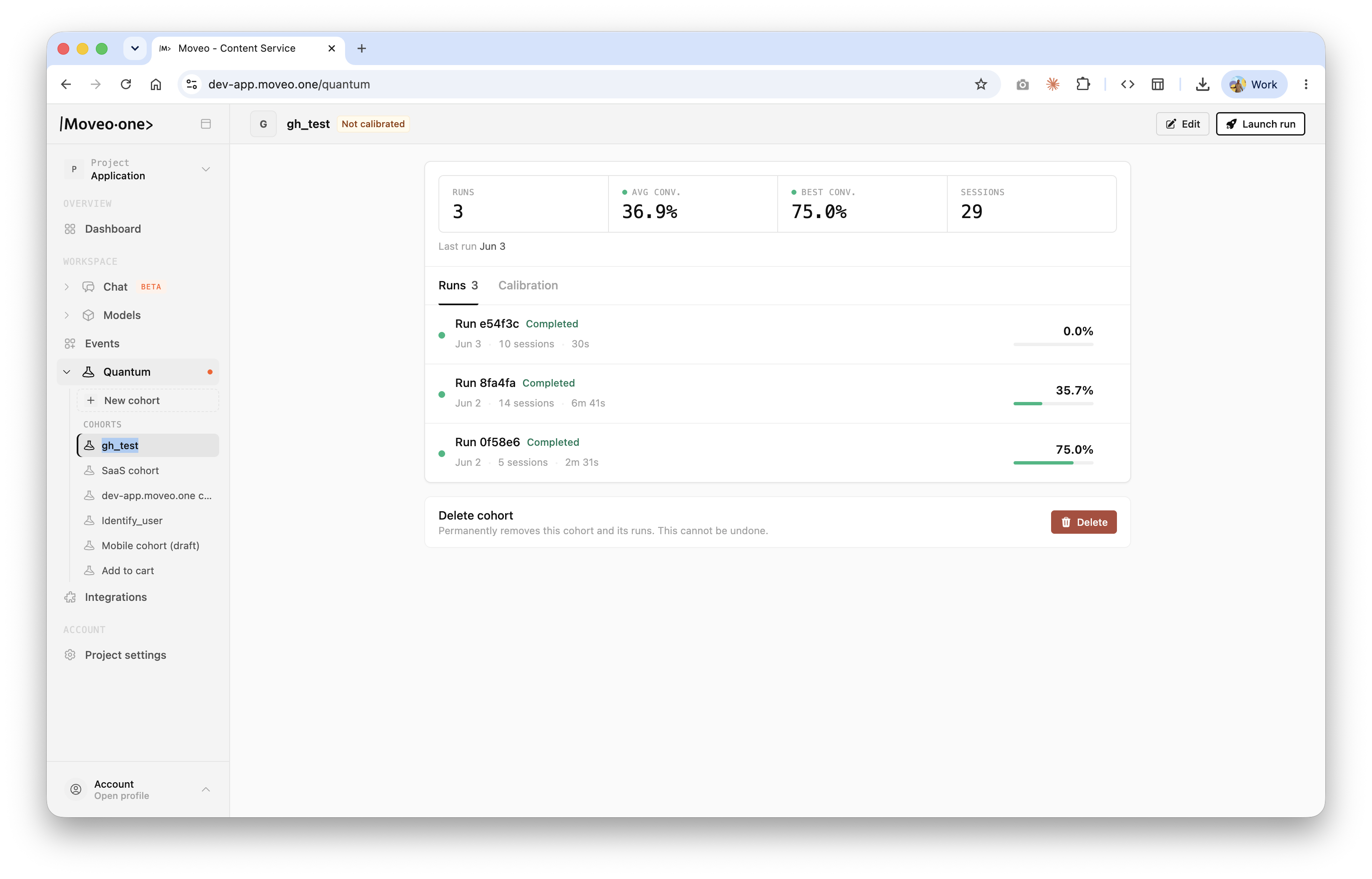
To simulate one million concurrent users' behavior, you run a calibrated synthetic population through your flow and read how each cohort moves — where it converts, hesitates, and drops — rather than firing a million requests at your servers. Those are two different questions. Moveo One is a predictive behavioral intelligence platform, and its simulation pillar answers the behavioral one: not "can the infrastructure hold a million sessions?" but "what will a million users at this scale actually do inside the new flow?"
Behavioral simulation is not load testing
It is worth separating the two cleanly, because the same phrase gets used for both. Infrastructure load testing — the kind you run with tools that hammer an endpoint with synthetic traffic — answers a systems question: latency, error rates, autoscaling, throughput. It says nothing about whether the screen you just built makes sense to the people hitting it.
Behavioral simulation answers the product question. It models how a large, realistic user population would navigate a flow and where that population would stall. You can pass every load test in the world and still ship a redesign that quietly loses a chunk of your most valuable segment at step three. Simulating user behavior at scale is how you catch that before launch, which is the same discipline at the heart of how to test a feature before launching.
How to simulate user behavior at scale
The mechanism is calibration, not volume for its own sake. Moveo One trains a behavioral model on your real event data and calibrates a synthetic agent population to your actual cohorts — power users, casual users, at-risk users — each behaving the way that group behaves in production. Running a large cohort through a new flow then converges into a counterfactual against your baseline: each agent is marked converted or bounced, and the predicted drop-off is broken out by segment.
The point of scale here is statistical resolution. A small sample tells you the average; a large calibrated cohort tells you what happens to the edges — the segment that is only five percent of traffic but a large share of revenue, the cohort whose behavior diverges sharply from the mean. That granularity is where the useful surprises live, and it is closely related to coding user prediction into your own flows.
Why Moveo One
Moveo One simulates user behavior at scale by running cohorts calibrated to your real data through your product, predicting how each segment moves before you ship — behavioral simulation, distinct from infrastructure load testing. Because the agents are calibrated rather than generated from a prompt, the drop-off they predict is grounded in how your users genuinely behave. You can explore the broader pre-launch workflow under test before you launch, and how this fits a data monitoring setup. If you are weighing approaches, it also helps to read synthetic monitoring versus real user monitoring.
In practice: predicting drop-off across a large user base
A team wanted to see how a large user base would move through a new flow before exposing it to live traffic. Rather than waiting for a staged rollout to reveal problems, they ran calibrated synthetic cohorts through the flow and read predicted drop-off segment by segment. The simulation showed where specific cohorts would stall — information they used to fix the friction first, so the eventual launch confirmed the prediction instead of discovering the problem.
Frequently asked questions
Is this the same as load testing one million users?
No. Load testing checks whether your infrastructure can handle the traffic — latency, errors, throughput. Behavioral simulation predicts what users will do inside the flow: where they convert, hesitate, and drop. Moveo One does the second.
How can synthetic users represent real behavior at scale?
The agents are calibrated to your real behavioral cohorts from your own event data, not generated from a prompt. So a large synthetic population behaves the way your actual segments behave, and the predicted drop-off reflects real patterns rather than invented ones.
Why simulate at large scale rather than a small sample?
Scale gives statistical resolution. A small sample shows the average; a large calibrated cohort reveals what happens to the edges — small but high-value segments whose behavior diverges from the mean, which is usually where the useful surprises are.
Testing an iOS app specifically? For the iOS simulation workflow before a TestFlight build, see how to simulate a ton of users in an iOS app.
Keep exploring: synthetic monitoring vs real user monitoring · test a feature before launching · browse all use cases
Keep exploring
Related use cases
Same Analytics Everywhere — Derive Consistent Conclusions Across All Platforms
How to get consistent analytics across platforms: Moveo One unifies iOS, Android, and web behavior into one model-level layer, so Flutter, React Native, and MAUI apps produce comparable conclusions instead of drifting dashboards.
Agentic AI Software Testing With Behavior-Calibrated Users
Agentic AI software testing predicts where real users would stall before launch. Moveo One runs behavior-calibrated synthetic users through your flow, not just code checks.
How to Code User Prediction Without Building an ML Pipeline
How to code user prediction: Moveo One trains a behavioral model on your real events and returns per-user predictions over an API, so you ship intent scores without an ML stack.