How to Simulate a Ton of Users in an iOS App Before Launch
How to simulate a ton of users in an iOS app: Moveo One runs calibrated synthetic users through your flows to predict how real cohorts behave before release, not load or performance testing.

For Developer
Role-focused use case
To simulate a ton of users in an iOS app in a way that actually predicts behavior, you run a calibrated synthetic population through your flows and read where they would drop off — not a swarm of scripted bots hammering your servers. Moveo One is a predictive behavioral intelligence platform with a native iOS SDK. For iOS, it models how thousands of users in your real cohorts would move through onboarding, a paywall, or a new feature, and returns predicted drop-off per step before a single TestFlight build reaches a real person.
Behavioral simulation is not load testing
The phrase "simulate a ton of users" usually triggers two different mental images, and conflating them wastes weeks. Load and performance testing — XCUITest at scale, traffic generators, stress harnesses — answers an infrastructure question: does the app stay up and fast when 100,000 sessions hit at once? That matters, but it tells you nothing about whether those 100,000 people will finish onboarding.
Behavioral simulation answers the human question instead: of the users who arrive, how many reach the goal, and where do the rest abandon? You can't get that from a bot that taps through a happy path, because a bot has no intent — it never hesitates, never bounces, never represents the segment that quits at the permission prompt. To predict behavior you need agents that behave like your real cohorts, which is a modeling problem, not a throughput problem.
How calibrated synthetic users model your iOS flows
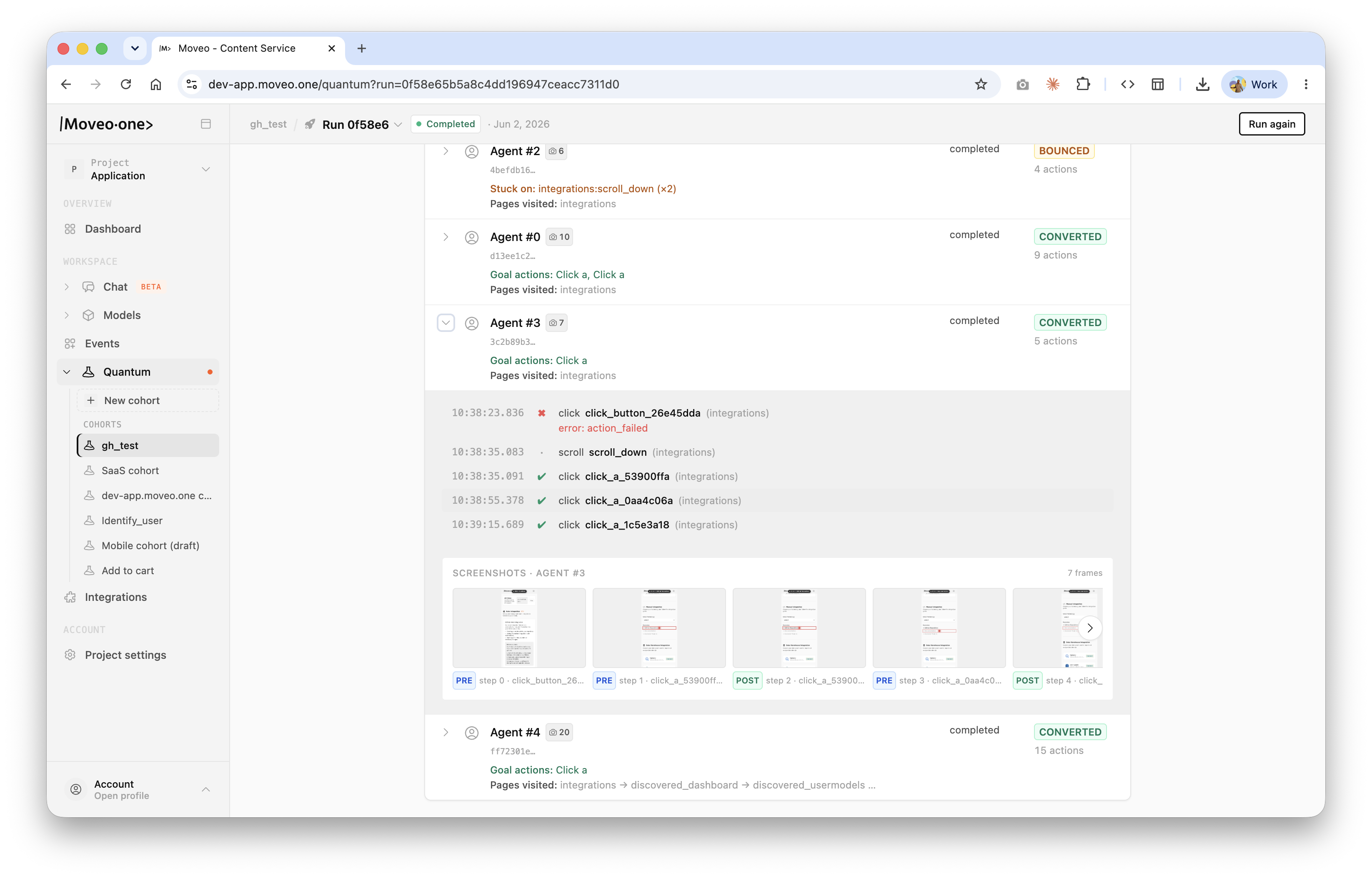
Moveo One starts from your real product events and builds a behavioral model of how your segments actually move. It then calibrates synthetic cohorts to match those segments — not generated personas or prompt-invented profiles, but agents grounded in measured behavior — and runs them forward through the flow you want to ship. Each run converges into a counterfactual against your baseline, with agents marked converted or bounced, so you read predicted completion and the specific step where people leak.
For an iOS release that means you can pressure-test a redesigned onboarding, a reworked paywall, or a gated feature and see the predicted opening rate before code freeze. It is the Simulate pillar in one line: simulate before you ship. The same mechanism scales beyond mobile in how to simulate 1m concurrent users, and if you're weighing it against uptime tooling, synthetic monitoring vs real user monitoring draws the line between the two.
Why Moveo One
Moveo One runs calibrated synthetic users through your iOS flows to predict how real cohorts behave — behavioral simulation, not load or performance testing. That distinction is the whole value: it catches the friction that crashes your funnel, not the friction that crashes your servers. Because the population is calibrated to your actual data, the predicted drop-off reflects how your real segments decide, so you fix the step that loses people instead of guessing. It fits naturally for a native mobile app team and lets you test before you launch rather than learning from a bad release in production.
In practice: catching onboarding friction before a big release
Before a major iOS release, a team modeled how their different user segments would move through onboarding. Rather than wait for live retention numbers to reveal the problem, they ran calibrated synthetic cohorts through the new flow and watched where each segment stalled. The simulation surfaced the friction point ahead of launch, so the fix shipped in the same release instead of arriving as a hotfix two weeks after the drop-off showed up in the analytics.
Frequently asked questions
Is simulating users the same as load testing an iOS app?
No. Load testing checks whether your infrastructure stays fast and stable under heavy traffic. Simulating users in Moveo One's sense predicts human behavior — how many people complete a flow and where the rest abandon. Load testing uses scripted bots with no intent; behavioral simulation uses cohorts calibrated to your real users, so the result reflects real decisions.
How does Moveo One simulate iOS users before launch?
It trains a behavioral model on your real product events, calibrates synthetic cohorts to match how your actual segments move, and runs them through a flow that isn't live yet. Each run converges into a counterfactual against your baseline with agents marked converted or bounced, giving you predicted drop-off per step before any real user sees the build.
Are the synthetic users just generated personas?
No. They are calibrated to your real behavioral cohorts, grounded in measured product events rather than invented or prompt-generated profiles. That calibration is what makes the predicted behavior trustworthy, because the agents move the way your real segments actually do.
Need massive-scale behavior instead? For simulating a million concurrent users' behavior, see how to simulate 1M concurrent users.
Keep exploring: predictive analytics tools · how to code user prediction · browse all use cases
Keep exploring
Related use cases
Same Analytics Everywhere — Derive Consistent Conclusions Across All Platforms
How to get consistent analytics across platforms: Moveo One unifies iOS, Android, and web behavior into one model-level layer, so Flutter, React Native, and MAUI apps produce comparable conclusions instead of drifting dashboards.
Agentic AI Software Testing With Behavior-Calibrated Users
Agentic AI software testing predicts where real users would stall before launch. Moveo One runs behavior-calibrated synthetic users through your flow, not just code checks.
How to Code User Prediction Without Building an ML Pipeline
How to code user prediction: Moveo One trains a behavioral model on your real events and returns per-user predictions over an API, so you ship intent scores without an ML stack.