Predictive Analytics Tools That Act, Not Just Chart
Predictive analytics tools usually stop at a dashboard. Moveo One wires per-user predictions into nudges and paywalls, so the forecast changes the outcome in real time.

For Data Scientist
Role-focused use case
How it works
- 1Connect your data
- 2Train predictive models
- 3Wire predictions to nudges and paywalls
- 4Measure the outcome
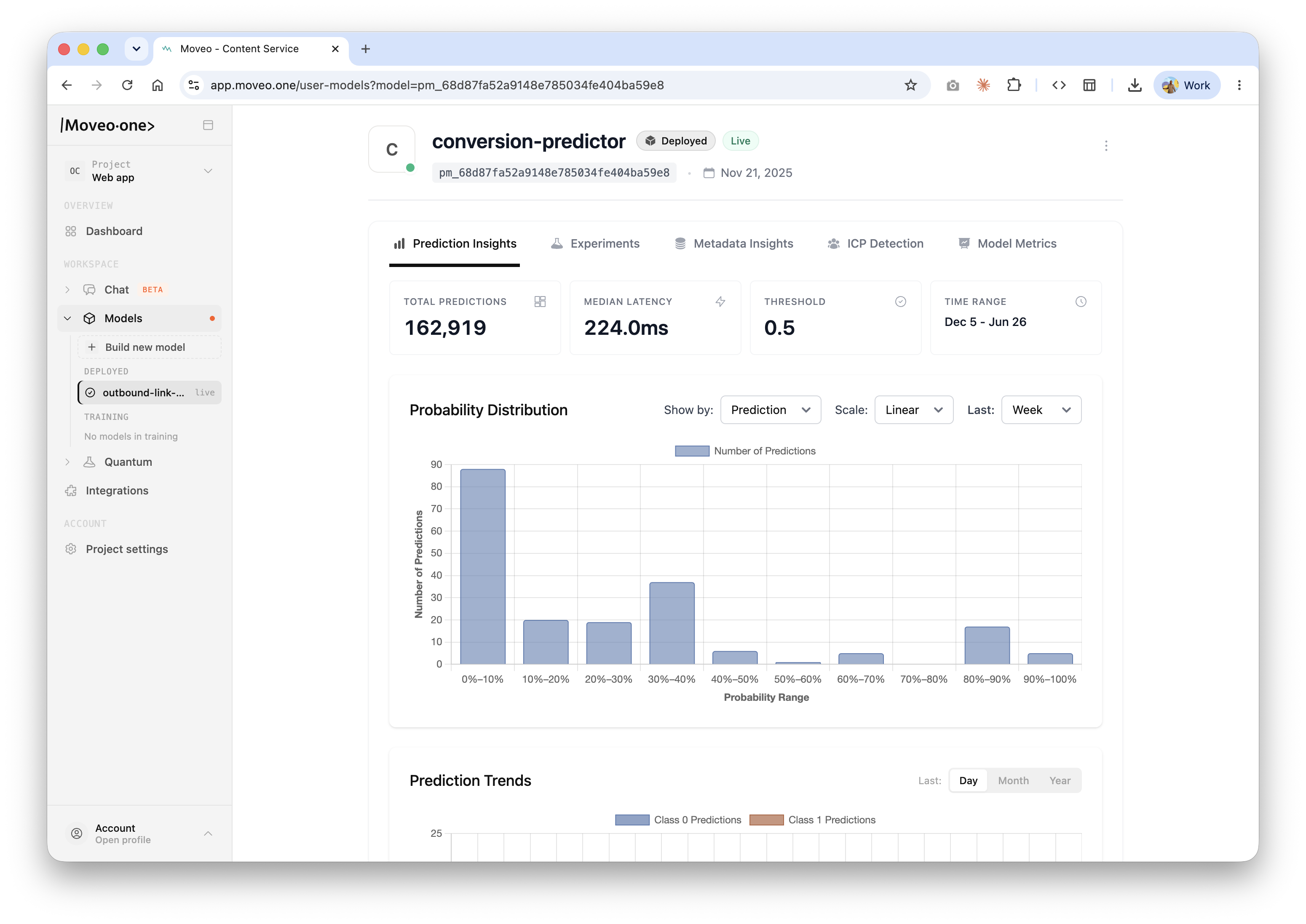
The best predictive analytics tools don't just forecast what will happen — they put that forecast to work inside the product while there's still time to change it. Moveo One is a predictive behavioral intelligence platform designed to act on its own forecasts. Instead of leaving a churn or activation prediction sitting in a chart, it returns a calibrated per-user probability over an API and connects that score directly to a nudge, a paywall, or a save — so the prediction moves the metric instead of describing it.
What predictive analytics tools actually do
Predictive analytics applies machine learning to historical events to estimate future ones: which trial will convert, which account is about to churn, which session is heading for abandonment. Understanding how predictive analytics helps business comes down to one shift — you stop reacting to outcomes after they land and start acting on them while they're still forming. A weekly churn report tells you who already left. A per-user prediction score, refreshed as behavior unfolds, tells you who is leaving next and gives you a window to intervene.
Most tools handle the first half of that loop well. They train a model, surface a probability distribution, and render it on a dashboard for an analyst to interpret. The gap is the second half: turning the number into an action the product takes automatically.
Advanced analytics vs predictive analytics
It helps to separate two things that often get bundled. The advanced analytics vs predictive analytics distinction is about direction in time. Advanced analytics — segmentation, cohort analysis, attribution — explains what already happened with more rigor than a basic report. Predictive analytics points forward: it assigns a probability to a future event for a specific user. Both matter, but only one of them can fire a nudge before the user bounces.
Moveo One sits firmly on the predictive side and grounds it in the Predict pillar. It trains a behavioral model on your real product events and returns a calibrated probability — an 80% means roughly eight in ten such users reach the event — with a median latency around 200ms, fast enough to act on inside a live session. You can stream events through its own SDKs (web, iOS, Android, React Native, Flutter) or connect an existing source like Amplitude, Mixpanel, PostHog, or Segment. If you're building this into your own stack, how to code user prediction walks through wiring scores into product logic.
Why Moveo One
Most predictive analytics tools stop at a chart; Moveo One turns the prediction into a per-user action inside your product, so the forecast actually changes the outcome. The score isn't a static export — it's a live signal you can route to a paywall decision, a contextual prompt, or a sales handoff at the moment intent is highest. Because every prediction is calibrated and carries the behavioral reasons behind it, the action you take is grounded in cause rather than a hunch. You can explore the broader set of outcomes this drives under predict outcomes in real time, and see how it maps onto a web application specifically.
In practice: predictions wired to action
A growth team evaluating predictive analytics tools didn't want another dashboard to monitor — they wanted activation and churn predictions wired straight into nudges and paywalls. The pattern they landed on was simple: score each user's probability to activate, trigger an in-product prompt for the ones stalling before activation, and reserve the paywall push for users already predicted to convert. The forecast stopped being a report someone read on Monday and became a decision the product made in the moment. That's the difference between watching a number fall and catching the users before it does.
Frequently asked questions
How are predictive analytics tools different from a BI dashboard?
A BI dashboard summarizes what already happened across segments and time. Predictive analytics assigns a forward-looking probability to a future event for each user — for example, the chance this specific trial converts. Moveo One goes one step further and routes that probability into a product action while the user is still in the session.
How does predictive analytics help a business?
It shifts effort from reacting to outcomes to shaping them. Instead of emailing churned users after they leave, you predict who is about to leave and intervene first; instead of treating all signups the same, you focus the paywall on users predicted to convert. The value comes from acting on the prediction, not just reading it.
What is the difference between advanced analytics and predictive analytics?
Advanced analytics explains the past with more depth — richer segmentation, cohort and attribution analysis. Predictive analytics estimates a future event for a specific user and attaches a probability to it. Moveo One is predictive: it forecasts per-user behavior and connects the score to real-time action.
Does Moveo One replace my existing analytics?
No. It connects to sources you already run — Amplitude, Mixpanel, PostHog, Segment — or collects events through its own SDKs, then adds the prediction layer on top. Your analytics keeps measuring; Moveo One predicts and acts.
Keep exploring: how to increase conversion rate · behavior AI · browse all use cases
Keep exploring
Related use cases
Build a Predictive Model to Improve Conversion
How to build a predictive model that improves conversion: Moveo One trains on your real behavior and scores each session's likelihood to convert in real time, so you act on hesitation before the sale is lost.
Same Analytics Everywhere — Derive Consistent Conclusions Across All Platforms
How to get consistent analytics across platforms: Moveo One unifies iOS, Android, and web behavior into one model-level layer, so Flutter, React Native, and MAUI apps produce comparable conclusions instead of drifting dashboards.
Customer Churn Prediction: Score Every User Before They Leave
Customer churn prediction done right: Moveo One scores every user's calibrated probability to churn — plus the reason why — so you intervene before they leave.