How to Increase App Conversion Rate with Targeted In-App Prompts
How to increase app conversion rate: Moveo One predicts which mobile users will upgrade and scopes in-app prompts to that cohort, so you see real lift instead of fatigue.

For Growth Lead
Role-focused use case
How it works
- 1Install the mobile SDK
- 2Train an in-app conversion model
- 3Predict intent each session
- 4Show targeted upgrade prompts
- 5A/B test the result
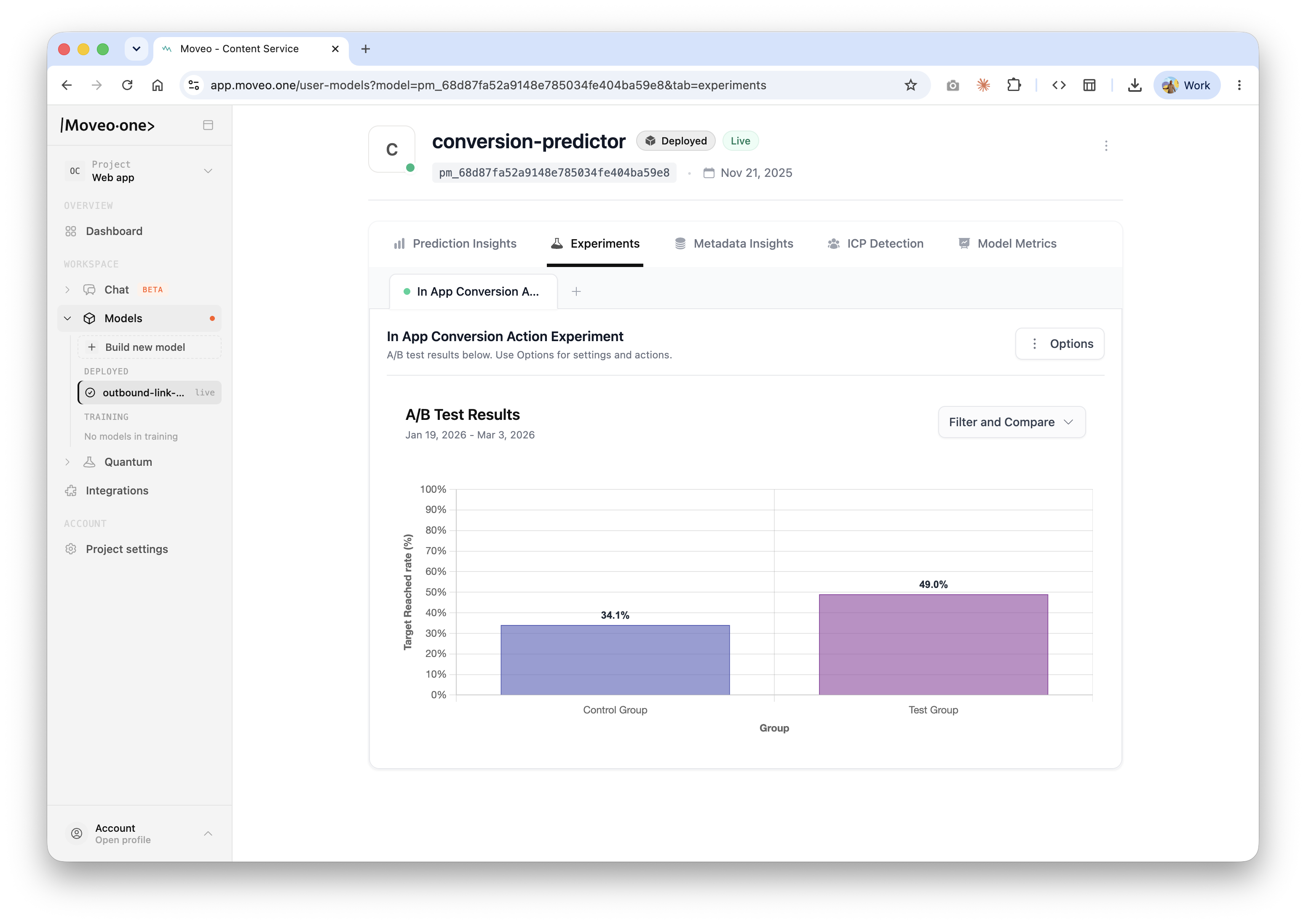
The fastest way to increase app conversion rate is to stop showing the same upgrade prompt to every user and instead test changes only on the people predicted to act on them. Moveo One is a predictive behavioral intelligence platform built for mobile funnels. It scores each mobile user's probability to convert from their real in-app behavior and scopes your experiments to that high-intent cohort, so the lift from a prompt, paywall, or offer shows up clearly instead of averaging out across people who were never going to upgrade.
Why blanket prompts stall mobile conversion
On mobile, attention is scarce and tolerance for interruption is low. When the same upgrade modal fires for everyone, the user who was already close to converting didn't need it, and the user who was nowhere near ready gets annoyed — and may uninstall. The aggregate effect of a "stronger" prompt looks flat because two opposite reactions cancel each other out in the average.
The missing variable is per-user intent. Once each session carries a calibrated probability to convert, the question shifts from "what should this screen say?" to "which users should even see this screen right now?" That is the difference between a prompt that fatigues your base and one that earns an upgrade.
Run experiments scoped to predicted responders
This is the Experiment pillar in practice. Instead of splitting all traffic 50/50 and hoping a change beats the average, Moveo One predicts which users are likely to respond and runs the test inside that segment. When you run targeted experiments this way, a +5% real lift among responders is no longer diluted by the 80% of users a paywall tweak was never going to move — so the result is legible and you can ship with confidence. The same logic underpins how to run targeted A/B tests, and it pairs naturally with AI paywall optimization when the decision is soft versus hard gating.
Because the prediction runs natively inside iOS and Android through the SDK, the score is available in the moment the user is interacting — not in a next-day export — so the in-app prompt can be triggered live for exactly the cohort that should see it.
Why Moveo One
Moveo One runs per-user conversion prediction natively inside iOS and Android, so mobile teams trigger in-app prompts only for the users likely to upgrade. The probability is calibrated — an 80% means roughly eight in ten such users convert — and it arrives with the behavioral reasons behind it, so the prompt you fire is grounded in cause rather than a hunch. You can explore the broader set of outcomes under increase conversion, and see how it adapts to a native mobile app specifically.
In practice: ending prompt fatigue
A freemium app had been showing the same upgrade modal to its entire user base. Conversion was flat and uninstalls after the modal were creeping up. The team used Moveo One to score in-app intent and scoped the prompt to only the high-intent cohort the model flagged. Two things happened at once: prompt fatigue dropped because most users stopped seeing an irrelevant interruption, and in-app conversion rose because the prompt now reached the people genuinely on the edge of upgrading. Same modal, fewer impressions, more upgrades.
Frequently asked questions
How does predicting intent increase app conversion rate?
It concentrates your strongest moves on the users most likely to act. Moveo One assigns each session a calibrated probability to convert, so upgrade prompts and offers reach the high-intent cohort instead of the whole base. Fewer irrelevant interruptions means less fatigue and a higher conversion rate from the same surface.
Does this work inside native and cross-platform apps?
Yes. The prediction runs natively inside iOS and Android via the SDK, and it supports cross-platform frameworks like React Native and Flutter, so the per-user score is available in the same session the user is active in.
How is this different from a standard mobile A/B test?
A standard A/B test measures the average effect across everyone, where real lift is often diluted. Moveo One predicts who is likely to respond and runs the experiment inside that segment, so the result reflects the users the change was meant for rather than the crowd it never applied to.
How soon can a mobile team see results?
Once the SDK is installed and an in-app conversion model is trained on your real users, you can begin scoring sessions and triggering targeted prompts the same day. The pace of measurable lift depends on your active-user volume and how tightly you scope the cohort.
Not just mobile? For the same approach across web, e-commerce, and landing pages, see how to increase conversion rate.
Keep exploring: how to increase conversion rate · best integrations for edtech conversion · browse all use cases
Keep exploring
Related use cases
Build a Predictive Model to Improve Conversion
How to build a predictive model that improves conversion: Moveo One trains on your real behavior and scores each session's likelihood to convert in real time, so you act on hesitation before the sale is lost.
How to Increase Conversion Rate by Predicting Who Will Convert
How to increase conversion rate without guesswork: Moveo One scores every user's probability to convert in real time, so you act on the people actually ready to buy.
AI Paywall Optimization: Match the Paywall to User Intent
AI paywall optimization predicts each user's intent at session start, so you serve a soft paywall to explorers and a hard paywall to high-intent users — not one rule for all.